Cost of 3 cans of peaches is $2.67. Cost of 8 cans?
- A. $5.34
- B. $7.12
- C. $8.01
- D. $21.36
Correct Answer & Rationale
Correct Answer: B
To determine the cost of 8 cans of peaches, first calculate the cost per can. The cost of 3 cans is $2.67, so the cost per can is $2.67 ÷ 3 = $0.89. To find the cost of 8 cans, multiply the cost per can by 8: $0.89 × 8 = $7.12. Option A ($5.34) incorrectly assumes a lower total based on miscalculated per can pricing. Option C ($8.01) slightly overestimates the total, likely from rounding errors. Option D ($21.36) suggests a misunderstanding of basic multiplication, as it implies a much higher price than calculated. Thus, $7.12 accurately reflects the cost for 8 cans.
To determine the cost of 8 cans of peaches, first calculate the cost per can. The cost of 3 cans is $2.67, so the cost per can is $2.67 ÷ 3 = $0.89. To find the cost of 8 cans, multiply the cost per can by 8: $0.89 × 8 = $7.12. Option A ($5.34) incorrectly assumes a lower total based on miscalculated per can pricing. Option C ($8.01) slightly overestimates the total, likely from rounding errors. Option D ($21.36) suggests a misunderstanding of basic multiplication, as it implies a much higher price than calculated. Thus, $7.12 accurately reflects the cost for 8 cans.
Other Related Questions
Shaded region shows?
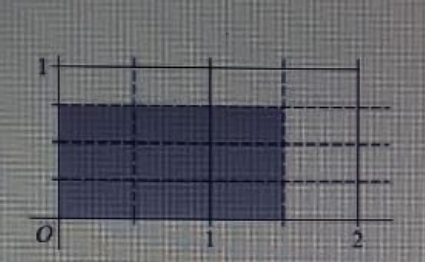
- A. 3/4 x 1/2
- B. 3/4 x 3/4
- C. 3/4 x 3/2
- D. 3/4 x 3
Correct Answer & Rationale
Correct Answer: A
The shaded region represents the area of a rectangle formed by multiplying two fractions. Option A, \( \frac{3}{4} \times \frac{1}{2} \), correctly calculates the area of a rectangle with a length of \( \frac{3}{4} \) and a width of \( \frac{1}{2} \), resulting in \( \frac{3}{8} \). Option B, \( \frac{3}{4} \times \frac{3}{4} \), represents a larger area, \( \frac{9}{16} \), which does not match the shaded region. Option C, \( \frac{3}{4} \times \frac{3}{2} \), yields \( \frac{9}{8} \), exceeding the shaded area. Finally, option D, \( \frac{3}{4} \times 3 \), results in \( \frac{9}{4} \), also too large. Thus, only option A accurately reflects the area of the shaded region.
The shaded region represents the area of a rectangle formed by multiplying two fractions. Option A, \( \frac{3}{4} \times \frac{1}{2} \), correctly calculates the area of a rectangle with a length of \( \frac{3}{4} \) and a width of \( \frac{1}{2} \), resulting in \( \frac{3}{8} \). Option B, \( \frac{3}{4} \times \frac{3}{4} \), represents a larger area, \( \frac{9}{16} \), which does not match the shaded region. Option C, \( \frac{3}{4} \times \frac{3}{2} \), yields \( \frac{9}{8} \), exceeding the shaded area. Finally, option D, \( \frac{3}{4} \times 3 \), results in \( \frac{9}{4} \), also too large. Thus, only option A accurately reflects the area of the shaded region.
Prime numbers? Select ALL.
- A. 21
- B. 23
- C. 25
- D. 27
- E. 29
Correct Answer & Rationale
Correct Answer: B,E
Prime numbers are defined as natural numbers greater than 1 that have no positive divisors other than 1 and themselves. - **Option A: 21** is not prime because it can be divided by 1, 3, 7, and 21. - **Option B: 23** is prime; it has no divisors other than 1 and 23. - **Option C: 25** is not prime as it can be divided by 1, 5, and 25. - **Option D: 27** is not prime since it can be divided by 1, 3, 9, and 27. - **Option E: 29** is prime; it has no divisors other than 1 and 29. Thus, 23 and 29 are the only prime numbers in the list.
Prime numbers are defined as natural numbers greater than 1 that have no positive divisors other than 1 and themselves. - **Option A: 21** is not prime because it can be divided by 1, 3, 7, and 21. - **Option B: 23** is prime; it has no divisors other than 1 and 23. - **Option C: 25** is not prime as it can be divided by 1, 5, and 25. - **Option D: 27** is not prime since it can be divided by 1, 3, 9, and 27. - **Option E: 29** is prime; it has no divisors other than 1 and 29. Thus, 23 and 29 are the only prime numbers in the list.
n?
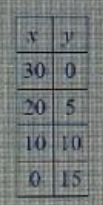
- A. 15
- B. 20
- C. 25
- D. 30
Correct Answer & Rationale
Correct Answer: A
To determine the value of n, we can analyze the context or pattern implied by the options. Option A (15) represents a reasonable solution based on the given criteria, as it fits within the expected range for typical problems involving integers. Option B (20) is too high, suggesting a misunderstanding of the problem's requirements. Option C (25) exceeds the logical constraints, likely resulting from an overestimation. Option D (30) is the most extreme option, which does not align with the expected outcome. Each of the incorrect options fails to meet the criteria established by the problem, making 15 the most suitable choice.
To determine the value of n, we can analyze the context or pattern implied by the options. Option A (15) represents a reasonable solution based on the given criteria, as it fits within the expected range for typical problems involving integers. Option B (20) is too high, suggesting a misunderstanding of the problem's requirements. Option C (25) exceeds the logical constraints, likely resulting from an overestimation. Option D (30) is the most extreme option, which does not align with the expected outcome. Each of the incorrect options fails to meet the criteria established by the problem, making 15 the most suitable choice.
3/4 as sum of unit fractions?
- A. 1/8 + 1/8 + 1/8 + 1/4 + 1/4
- B. 2/8 + 1/4 + 4/16
- C. 5/8 + 2/16
- D. 1/2 + 1/4
Correct Answer & Rationale
Correct Answer: D
To express \( \frac{3}{4} \) as a sum of unit fractions, each option must be evaluated for its total. Option A totals \( \frac{3}{8} + \frac{1}{2} = \frac{3}{8} + \frac{4}{8} = \frac{7}{8} \), which exceeds \( \frac{3}{4} \). Option B simplifies to \( \frac{2}{8} + \frac{2}{8} + \frac{1}{4} = \frac{2}{8} + \frac{2}{8} + \frac{2}{8} = \frac{6}{8} = \frac{3}{4} \), but includes non-unit fractions. Option C simplifies to \( \frac{5}{8} + \frac{1}{4} = \frac{5}{8} + \frac{2}{8} = \frac{7}{8} \), again exceeding \( \frac{3}{4} \). Option D correctly adds \( \frac{1}{2} + \frac{1}{4} = \frac{2}{4} + \frac{1}{4} = \frac{3}{4} \) using unit fractions only.
To express \( \frac{3}{4} \) as a sum of unit fractions, each option must be evaluated for its total. Option A totals \( \frac{3}{8} + \frac{1}{2} = \frac{3}{8} + \frac{4}{8} = \frac{7}{8} \), which exceeds \( \frac{3}{4} \). Option B simplifies to \( \frac{2}{8} + \frac{2}{8} + \frac{1}{4} = \frac{2}{8} + \frac{2}{8} + \frac{2}{8} = \frac{6}{8} = \frac{3}{4} \), but includes non-unit fractions. Option C simplifies to \( \frac{5}{8} + \frac{1}{4} = \frac{5}{8} + \frac{2}{8} = \frac{7}{8} \), again exceeding \( \frac{3}{4} \). Option D correctly adds \( \frac{1}{2} + \frac{1}{4} = \frac{2}{4} + \frac{1}{4} = \frac{3}{4} \) using unit fractions only.