Point (-3,-6) quadrant?
- A. I
- B. II
- C. III
- D. IV
Correct Answer & Rationale
Correct Answer: C
The point (-3, -6) is located in the Cartesian coordinate system where the x-coordinate is negative and the y-coordinate is also negative. This combination places the point in Quadrant III, where both x and y values are less than zero. Option A (I) is incorrect as Quadrant I contains positive x and y values. Option B (II) is wrong because Quadrant II has a negative x value and a positive y value. Option D (IV) is not applicable since Quadrant IV features a positive x value and a negative y value. Thus, the only quadrant that matches the coordinates (-3, -6) is Quadrant III.
The point (-3, -6) is located in the Cartesian coordinate system where the x-coordinate is negative and the y-coordinate is also negative. This combination places the point in Quadrant III, where both x and y values are less than zero. Option A (I) is incorrect as Quadrant I contains positive x and y values. Option B (II) is wrong because Quadrant II has a negative x value and a positive y value. Option D (IV) is not applicable since Quadrant IV features a positive x value and a negative y value. Thus, the only quadrant that matches the coordinates (-3, -6) is Quadrant III.
Other Related Questions
Shaded region shows?
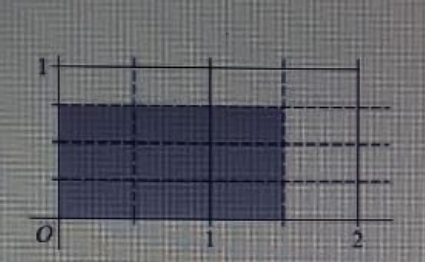
- A. 3/4 x 1/2
- B. 3/4 x 3/4
- C. 3/4 x 3/2
- D. 3/4 x 3
Correct Answer & Rationale
Correct Answer: A
The shaded region represents the area of a rectangle formed by multiplying two fractions. Option A, \( \frac{3}{4} \times \frac{1}{2} \), correctly calculates the area of a rectangle with a length of \( \frac{3}{4} \) and a width of \( \frac{1}{2} \), resulting in \( \frac{3}{8} \). Option B, \( \frac{3}{4} \times \frac{3}{4} \), represents a larger area, \( \frac{9}{16} \), which does not match the shaded region. Option C, \( \frac{3}{4} \times \frac{3}{2} \), yields \( \frac{9}{8} \), exceeding the shaded area. Finally, option D, \( \frac{3}{4} \times 3 \), results in \( \frac{9}{4} \), also too large. Thus, only option A accurately reflects the area of the shaded region.
The shaded region represents the area of a rectangle formed by multiplying two fractions. Option A, \( \frac{3}{4} \times \frac{1}{2} \), correctly calculates the area of a rectangle with a length of \( \frac{3}{4} \) and a width of \( \frac{1}{2} \), resulting in \( \frac{3}{8} \). Option B, \( \frac{3}{4} \times \frac{3}{4} \), represents a larger area, \( \frac{9}{16} \), which does not match the shaded region. Option C, \( \frac{3}{4} \times \frac{3}{2} \), yields \( \frac{9}{8} \), exceeding the shaded area. Finally, option D, \( \frac{3}{4} \times 3 \), results in \( \frac{9}{4} \), also too large. Thus, only option A accurately reflects the area of the shaded region.
Cost of 3 cans of peaches is $2.67. Cost of 8 cans?
- A. $5.34
- B. $7.12
- C. $8.01
- D. $21.36
Correct Answer & Rationale
Correct Answer: B
To determine the cost of 8 cans of peaches, first calculate the cost per can. The cost of 3 cans is $2.67, so the cost per can is $2.67 ÷ 3 = $0.89. To find the cost of 8 cans, multiply the cost per can by 8: $0.89 × 8 = $7.12. Option A ($5.34) incorrectly assumes a lower total based on miscalculated per can pricing. Option C ($8.01) slightly overestimates the total, likely from rounding errors. Option D ($21.36) suggests a misunderstanding of basic multiplication, as it implies a much higher price than calculated. Thus, $7.12 accurately reflects the cost for 8 cans.
To determine the cost of 8 cans of peaches, first calculate the cost per can. The cost of 3 cans is $2.67, so the cost per can is $2.67 ÷ 3 = $0.89. To find the cost of 8 cans, multiply the cost per can by 8: $0.89 × 8 = $7.12. Option A ($5.34) incorrectly assumes a lower total based on miscalculated per can pricing. Option C ($8.01) slightly overestimates the total, likely from rounding errors. Option D ($21.36) suggests a misunderstanding of basic multiplication, as it implies a much higher price than calculated. Thus, $7.12 accurately reflects the cost for 8 cans.
Which would be read as 'two million three hundred six thousand nine hundred thirty-four'?
- A. 2,036,934
- B. 2,306,934
- C. 2,360,934
- D. 2,369.03
Correct Answer & Rationale
Correct Answer: B
Option B, 2,306,934, accurately represents 'two million three hundred six thousand nine hundred thirty-four.' The number is broken down as follows: 2 million (2,000,000), 300 thousand (300,000), 6 thousand (6,000), 900 (900), and 30 (30), culminating in 2,306,934. Option A, 2,036,934, incorrectly includes only 30 thousand instead of 300 thousand. Option C, 2,360,934, misplaces the hundreds, showing 360 thousand instead of 306 thousand. Option D, 2,369.03, is not a whole number representation and introduces decimal values, which are irrelevant in this context.
Option B, 2,306,934, accurately represents 'two million three hundred six thousand nine hundred thirty-four.' The number is broken down as follows: 2 million (2,000,000), 300 thousand (300,000), 6 thousand (6,000), 900 (900), and 30 (30), culminating in 2,306,934. Option A, 2,036,934, incorrectly includes only 30 thousand instead of 300 thousand. Option C, 2,360,934, misplaces the hundreds, showing 360 thousand instead of 306 thousand. Option D, 2,369.03, is not a whole number representation and introduces decimal values, which are irrelevant in this context.
Greatest?
- A. 245 thousandths
- B. 24 hundredths
- C. 3 tenths
- D. 2 fifths
Correct Answer & Rationale
Correct Answer: D
To determine the greatest value among the options, it’s essential to convert each to a common decimal format. A: 245 thousandths equals 0.245. B: 24 hundredths equals 0.24. C: 3 tenths equals 0.3. D: 2 fifths equals 0.4 (since 2 divided by 5 is 0.4). Comparing these values, 0.4 (D) is greater than 0.3 (C), 0.24 (B), and 0.245 (A). Thus, option D represents the largest value. Options A, B, and C are all less than D, making them incorrect choices.
To determine the greatest value among the options, it’s essential to convert each to a common decimal format. A: 245 thousandths equals 0.245. B: 24 hundredths equals 0.24. C: 3 tenths equals 0.3. D: 2 fifths equals 0.4 (since 2 divided by 5 is 0.4). Comparing these values, 0.4 (D) is greater than 0.3 (C), 0.24 (B), and 0.245 (A). Thus, option D represents the largest value. Options A, B, and C are all less than D, making them incorrect choices.