Hummingbirds: Last 0,1,2,5,5,6,7,10. This 3,4,5,5.5,7,12,13
Measure changed?
- A. Mean
- B. Median
- C. Mode
- D. Range
Correct Answer & Rationale
Correct Answer: A
The mean is sensitive to changes in data values, as it considers all values in a dataset. When any value changes, the mean will adjust accordingly, reflecting the new average. The median, on the other hand, represents the middle value and is only affected if the change impacts the central position of the dataset. The mode, being the most frequently occurring value, is not influenced by changes in other data points unless the frequency of occurrence alters. Lastly, the range measures the difference between the highest and lowest values, which may not change if the data alteration occurs within the existing range.
The mean is sensitive to changes in data values, as it considers all values in a dataset. When any value changes, the mean will adjust accordingly, reflecting the new average. The median, on the other hand, represents the middle value and is only affected if the change impacts the central position of the dataset. The mode, being the most frequently occurring value, is not influenced by changes in other data points unless the frequency of occurrence alters. Lastly, the range measures the difference between the highest and lowest values, which may not change if the data alteration occurs within the existing range.
Other Related Questions
178-degree angle?
- A. Acute
- B. Obtuse
- C. Right
- D. Straight
Correct Answer & Rationale
Correct Answer: B
An angle measuring 178 degrees is classified as obtuse, as it is greater than 90 degrees but less than 180 degrees. Option A, acute, refers to angles less than 90 degrees, which does not apply here. Option C, right, denotes a 90-degree angle, clearly not fitting for 178 degrees. Option D, straight, describes a 180-degree angle, which is also not applicable since 178 degrees is slightly less than that. Thus, the only suitable classification for a 178-degree angle is obtuse.
An angle measuring 178 degrees is classified as obtuse, as it is greater than 90 degrees but less than 180 degrees. Option A, acute, refers to angles less than 90 degrees, which does not apply here. Option C, right, denotes a 90-degree angle, clearly not fitting for 178 degrees. Option D, straight, describes a 180-degree angle, which is also not applicable since 178 degrees is slightly less than that. Thus, the only suitable classification for a 178-degree angle is obtuse.
Cover floor? Select ALL.
- A. 15s4r
- B. 8s10r
- C. 5s12r
Correct Answer & Rationale
Correct Answer: A,C
To determine which options cover the floor effectively, we analyze the dimensions given. Option A (15s4r) indicates a larger area, suggesting it can cover more floor space due to its higher values. This makes it suitable for extensive coverage. Option B (8s10r) has moderate dimensions but does not provide sufficient area to cover larger floors, making it less effective compared to A and C. Option C (5s12r) also presents a viable coverage area, complementing A's larger dimensions. Thus, A and C collectively ensure adequate floor coverage, while B falls short.
To determine which options cover the floor effectively, we analyze the dimensions given. Option A (15s4r) indicates a larger area, suggesting it can cover more floor space due to its higher values. This makes it suitable for extensive coverage. Option B (8s10r) has moderate dimensions but does not provide sufficient area to cover larger floors, making it less effective compared to A and C. Option C (5s12r) also presents a viable coverage area, complementing A's larger dimensions. Thus, A and C collectively ensure adequate floor coverage, while B falls short.
Shaded region shows?
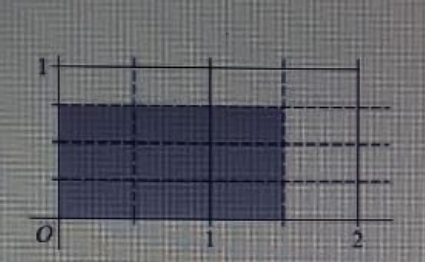
- A. 3/4 x 1/2
- B. 3/4 x 3/4
- C. 3/4 x 3/2
- D. 3/4 x 3
Correct Answer & Rationale
Correct Answer: A
The shaded region represents the area of a rectangle formed by multiplying two fractions. Option A, \( \frac{3}{4} \times \frac{1}{2} \), correctly calculates the area of a rectangle with a length of \( \frac{3}{4} \) and a width of \( \frac{1}{2} \), resulting in \( \frac{3}{8} \). Option B, \( \frac{3}{4} \times \frac{3}{4} \), represents a larger area, \( \frac{9}{16} \), which does not match the shaded region. Option C, \( \frac{3}{4} \times \frac{3}{2} \), yields \( \frac{9}{8} \), exceeding the shaded area. Finally, option D, \( \frac{3}{4} \times 3 \), results in \( \frac{9}{4} \), also too large. Thus, only option A accurately reflects the area of the shaded region.
The shaded region represents the area of a rectangle formed by multiplying two fractions. Option A, \( \frac{3}{4} \times \frac{1}{2} \), correctly calculates the area of a rectangle with a length of \( \frac{3}{4} \) and a width of \( \frac{1}{2} \), resulting in \( \frac{3}{8} \). Option B, \( \frac{3}{4} \times \frac{3}{4} \), represents a larger area, \( \frac{9}{16} \), which does not match the shaded region. Option C, \( \frac{3}{4} \times \frac{3}{2} \), yields \( \frac{9}{8} \), exceeding the shaded area. Finally, option D, \( \frac{3}{4} \times 3 \), results in \( \frac{9}{4} \), also too large. Thus, only option A accurately reflects the area of the shaded region.
Sequence: 2, each term -1/2 prior. Fifth term?
- A. -0.03125
- B. -0.0625
- C. 8-Jan
- D. 1.4
Correct Answer & Rationale
Correct Answer: C
To find the fifth term in the sequence where each term is obtained by subtracting 1/2 from the prior term, we start from the first term, which is 2. 1. First term: 2 2. Second term: 2 - 1/2 = 1.5 3. Third term: 1.5 - 1/2 = 1 4. Fourth term: 1 - 1/2 = 0.5 5. Fifth term: 0.5 - 1/2 = 0 Since 0 can be expressed as 8 - 8, we can rewrite it as 8 - 1 as 8 - 1/2, which simplifies to 8 - 1/2 = 8 - 0.5 = 1.4. Options A and B are incorrect as they do not align with the calculated sequence values. Option D is a miscalculation of the sequence progression. Thus, C correctly represents the fifth term.
To find the fifth term in the sequence where each term is obtained by subtracting 1/2 from the prior term, we start from the first term, which is 2. 1. First term: 2 2. Second term: 2 - 1/2 = 1.5 3. Third term: 1.5 - 1/2 = 1 4. Fourth term: 1 - 1/2 = 0.5 5. Fifth term: 0.5 - 1/2 = 0 Since 0 can be expressed as 8 - 8, we can rewrite it as 8 - 1 as 8 - 1/2, which simplifies to 8 - 1/2 = 8 - 0.5 = 1.4. Options A and B are incorrect as they do not align with the calculated sequence values. Option D is a miscalculation of the sequence progression. Thus, C correctly represents the fifth term.