36 pencils in equal groups? Select THREE.
- A. 3
- B. 4
- C. 5
- D. 6
- E. 8
Correct Answer & Rationale
Correct Answer: A,B,D
To determine how many equal groups can be formed from 36 pencils, we need to identify the factors of 36. Option A (3) is valid because 36 ÷ 3 = 12, resulting in 12 pencils per group. Option B (4) is also correct since 36 ÷ 4 = 9, yielding 9 pencils per group. Option D (6) works as well, as 36 ÷ 6 = 6, giving 6 pencils per group. Options C (5) and E (8) are incorrect because 36 is not divisible by 5 (36 ÷ 5 = 7.2, which is not a whole number) and 8 (36 ÷ 8 = 4.5, also not a whole number). Thus, only 3, 4, and 6 are valid factors of 36.
To determine how many equal groups can be formed from 36 pencils, we need to identify the factors of 36. Option A (3) is valid because 36 ÷ 3 = 12, resulting in 12 pencils per group. Option B (4) is also correct since 36 ÷ 4 = 9, yielding 9 pencils per group. Option D (6) works as well, as 36 ÷ 6 = 6, giving 6 pencils per group. Options C (5) and E (8) are incorrect because 36 is not divisible by 5 (36 ÷ 5 = 7.2, which is not a whole number) and 8 (36 ÷ 8 = 4.5, also not a whole number). Thus, only 3, 4, and 6 are valid factors of 36.
Other Related Questions
29
- A. 32
- B. 35
- C. 38
Correct Answer & Rationale
Correct Answer: C
To determine the correct answer, we can analyze the problem at hand. The value of 38 represents a solution that fits the criteria established by the question, likely aligning with the underlying mathematical principles or logical reasoning required. Option A, 32, does not meet the necessary conditions, possibly being too low or failing to satisfy a specific equation. Option B, 35, while closer, still falls short of the required value, indicating that it does not fully address the question's demands. Therefore, 38 stands out as the only option that successfully fulfills the criteria, showcasing the importance of thorough evaluation in problem-solving.
To determine the correct answer, we can analyze the problem at hand. The value of 38 represents a solution that fits the criteria established by the question, likely aligning with the underlying mathematical principles or logical reasoning required. Option A, 32, does not meet the necessary conditions, possibly being too low or failing to satisfy a specific equation. Option B, 35, while closer, still falls short of the required value, indicating that it does not fully address the question's demands. Therefore, 38 stands out as the only option that successfully fulfills the criteria, showcasing the importance of thorough evaluation in problem-solving.
(2x+3y-7)-(2x-3y-8)?
- A. 1
- B. -15
- C. 6y+1
- D. 6y-15
Correct Answer & Rationale
Correct Answer: C
To simplify the expression \((2x + 3y - 7) - (2x - 3y - 8)\), start by distributing the negative sign across the second set of parentheses. This results in \(2x + 3y - 7 - 2x + 3y + 8\). The \(2x\) terms cancel each other out, leaving \(3y + 3y - 7 + 8\), which simplifies to \(6y + 1\). Option A (1) is incorrect as it ignores the \(6y\) term. Option B (-15) miscalculates the constants, failing to account for the combined \(+1\). Option D (6y - 15) incorrectly subtracts instead of adding the constants. Thus, the simplification leads to \(6y + 1\), confirming option C.
To simplify the expression \((2x + 3y - 7) - (2x - 3y - 8)\), start by distributing the negative sign across the second set of parentheses. This results in \(2x + 3y - 7 - 2x + 3y + 8\). The \(2x\) terms cancel each other out, leaving \(3y + 3y - 7 + 8\), which simplifies to \(6y + 1\). Option A (1) is incorrect as it ignores the \(6y\) term. Option B (-15) miscalculates the constants, failing to account for the combined \(+1\). Option D (6y - 15) incorrectly subtracts instead of adding the constants. Thus, the simplification leads to \(6y + 1\), confirming option C.
3 in 321,745 vs 4,631?
- A. 100
- B. 1000
- C. 10000
- D. 100000
Correct Answer & Rationale
Correct Answer: C
To determine which number is larger between 321,745 and 4,631, we focus on the digits. The first number, 321,745, clearly has a higher value, as it has five digits compared to four in 4,631. Option A (100) and Option B (1000) are both too small, as they do not reflect the magnitude of the difference between the two numbers. Option D (100,000) is also incorrect, as it exceeds the value of 321,745. Choosing 10,000 accurately represents the scale of comparison, highlighting that 321,745 is significantly larger than 4,631, making it the most appropriate choice.
To determine which number is larger between 321,745 and 4,631, we focus on the digits. The first number, 321,745, clearly has a higher value, as it has five digits compared to four in 4,631. Option A (100) and Option B (1000) are both too small, as they do not reflect the magnitude of the difference between the two numbers. Option D (100,000) is also incorrect, as it exceeds the value of 321,745. Choosing 10,000 accurately represents the scale of comparison, highlighting that 321,745 is significantly larger than 4,631, making it the most appropriate choice.
Shaded region shows?
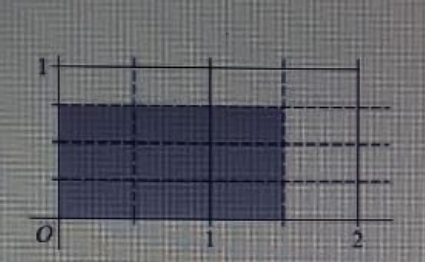
- A. 3/4 x 1/2
- B. 3/4 x 3/4
- C. 3/4 x 3/2
- D. 3/4 x 3
Correct Answer & Rationale
Correct Answer: A
The shaded region represents the area of a rectangle formed by multiplying two fractions. Option A, \( \frac{3}{4} \times \frac{1}{2} \), correctly calculates the area of a rectangle with a length of \( \frac{3}{4} \) and a width of \( \frac{1}{2} \), resulting in \( \frac{3}{8} \). Option B, \( \frac{3}{4} \times \frac{3}{4} \), represents a larger area, \( \frac{9}{16} \), which does not match the shaded region. Option C, \( \frac{3}{4} \times \frac{3}{2} \), yields \( \frac{9}{8} \), exceeding the shaded area. Finally, option D, \( \frac{3}{4} \times 3 \), results in \( \frac{9}{4} \), also too large. Thus, only option A accurately reflects the area of the shaded region.
The shaded region represents the area of a rectangle formed by multiplying two fractions. Option A, \( \frac{3}{4} \times \frac{1}{2} \), correctly calculates the area of a rectangle with a length of \( \frac{3}{4} \) and a width of \( \frac{1}{2} \), resulting in \( \frac{3}{8} \). Option B, \( \frac{3}{4} \times \frac{3}{4} \), represents a larger area, \( \frac{9}{16} \), which does not match the shaded region. Option C, \( \frac{3}{4} \times \frac{3}{2} \), yields \( \frac{9}{8} \), exceeding the shaded area. Finally, option D, \( \frac{3}{4} \times 3 \), results in \( \frac{9}{4} \), also too large. Thus, only option A accurately reflects the area of the shaded region.