Shaded region shows?
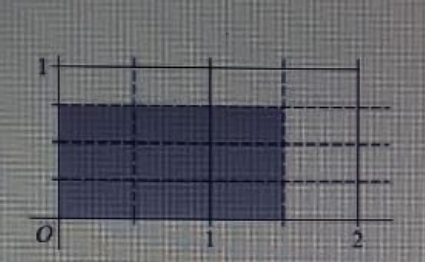
- A. 3/4 x 1/2
- B. 3/4 x 3/4
- C. 3/4 x 3/2
- D. 3/4 x 3
Correct Answer & Rationale
Correct Answer: A
The shaded region represents the area of a rectangle formed by multiplying two fractions. Option A, \( \frac{3}{4} \times \frac{1}{2} \), correctly calculates the area of a rectangle with a length of \( \frac{3}{4} \) and a width of \( \frac{1}{2} \), resulting in \( \frac{3}{8} \). Option B, \( \frac{3}{4} \times \frac{3}{4} \), represents a larger area, \( \frac{9}{16} \), which does not match the shaded region. Option C, \( \frac{3}{4} \times \frac{3}{2} \), yields \( \frac{9}{8} \), exceeding the shaded area. Finally, option D, \( \frac{3}{4} \times 3 \), results in \( \frac{9}{4} \), also too large. Thus, only option A accurately reflects the area of the shaded region.
The shaded region represents the area of a rectangle formed by multiplying two fractions. Option A, \( \frac{3}{4} \times \frac{1}{2} \), correctly calculates the area of a rectangle with a length of \( \frac{3}{4} \) and a width of \( \frac{1}{2} \), resulting in \( \frac{3}{8} \). Option B, \( \frac{3}{4} \times \frac{3}{4} \), represents a larger area, \( \frac{9}{16} \), which does not match the shaded region. Option C, \( \frac{3}{4} \times \frac{3}{2} \), yields \( \frac{9}{8} \), exceeding the shaded area. Finally, option D, \( \frac{3}{4} \times 3 \), results in \( \frac{9}{4} \), also too large. Thus, only option A accurately reflects the area of the shaded region.
Other Related Questions
15 + 3(7 + 1) - 12?
- A. 21
- B. 25
- C. 27
- D. 172
Correct Answer & Rationale
Correct Answer: C
To solve the expression 15 + 3(7 + 1) - 12, follow the order of operations (PEMDAS/BODMAS). First, calculate the expression inside the parentheses: 7 + 1 equals 8. Next, multiply by 3: 3 * 8 equals 24. Now, add 15: 15 + 24 equals 39. Finally, subtract 12: 39 - 12 equals 27. Option A (21) is incorrect as it does not account for the multiplication. Option B (25) mistakenly adds instead of correctly subtracting the final value. Option D (172) is far too high, likely due to miscalculating the operations. Thus, the final result is 27, confirming option C as the correct choice.
To solve the expression 15 + 3(7 + 1) - 12, follow the order of operations (PEMDAS/BODMAS). First, calculate the expression inside the parentheses: 7 + 1 equals 8. Next, multiply by 3: 3 * 8 equals 24. Now, add 15: 15 + 24 equals 39. Finally, subtract 12: 39 - 12 equals 27. Option A (21) is incorrect as it does not account for the multiplication. Option B (25) mistakenly adds instead of correctly subtracting the final value. Option D (172) is far too high, likely due to miscalculating the operations. Thus, the final result is 27, confirming option C as the correct choice.
d=rt, triple d, same t, new rate?
- A. 3dt
- B. (3d)/t
- C. t/(3d)
- D. d/(3t)
Correct Answer & Rationale
Correct Answer: B
In the equation d = rt, if distance (d) is tripled while time (t) remains constant, the new distance becomes 3d. To find the new rate (r'), we can rearrange the formula to r' = d/t. Substituting the new distance gives r' = (3d)/t, which is option B. Option A (3dt) incorrectly suggests multiplying distance by time, which does not represent rate. Option C (t/(3d)) misplaces the variables, implying time is divided by distance, which does not align with the rate formula. Option D (d/(3t)) incorrectly divides distance by three times the time, again misrepresenting the relationship between distance, rate, and time.
In the equation d = rt, if distance (d) is tripled while time (t) remains constant, the new distance becomes 3d. To find the new rate (r'), we can rearrange the formula to r' = d/t. Substituting the new distance gives r' = (3d)/t, which is option B. Option A (3dt) incorrectly suggests multiplying distance by time, which does not represent rate. Option C (t/(3d)) misplaces the variables, implying time is divided by distance, which does not align with the rate formula. Option D (d/(3t)) incorrectly divides distance by three times the time, again misrepresenting the relationship between distance, rate, and time.
Associative operations? Select ALL.
- A. Addition
- B. Subtraction
- C. Multiplication
- D. Division
- E. Exponentiation
Correct Answer & Rationale
Correct Answer: A,C
Associative operations allow the grouping of numbers in different ways without changing the result. Addition (A) and multiplication (C) are associative; for example, (a + b) + c = a + (b + c) and (a × b) × c = a × (b × c). Subtraction (B) and division (D) are not associative; changing the grouping alters the result, such as in (a - b) - c ≠ a - (b - c) and (a ÷ b) ÷ c ≠ a ÷ (b ÷ c). Exponentiation (E) is also not associative, as (a^b)^c ≠ a^(b^c). Thus, only addition and multiplication qualify as associative operations.
Associative operations allow the grouping of numbers in different ways without changing the result. Addition (A) and multiplication (C) are associative; for example, (a + b) + c = a + (b + c) and (a × b) × c = a × (b × c). Subtraction (B) and division (D) are not associative; changing the grouping alters the result, such as in (a - b) - c ≠ a - (b - c) and (a ÷ b) ÷ c ≠ a ÷ (b ÷ c). Exponentiation (E) is also not associative, as (a^b)^c ≠ a^(b^c). Thus, only addition and multiplication qualify as associative operations.
Measure pencil length?
- A. Millimeter
- B. Centimeter
- C. Meter
- D. Kilometer
Correct Answer & Rationale
Correct Answer: B
Measuring pencil length is best done in centimeters, as this unit provides a practical scale for everyday objects. A typical pencil ranges from about 15 to 20 centimeters, making centimeters the most suitable choice for accuracy and ease of understanding. Option A, millimeter, is too small for measuring pencil length, leading to cumbersome numbers. Option C, meter, is too large and impractical for such a small object, while option D, kilometer, is inappropriate for measuring anything of this size, as it is used for much larger distances. Thus, centimeters strike the perfect balance for this measurement.
Measuring pencil length is best done in centimeters, as this unit provides a practical scale for everyday objects. A typical pencil ranges from about 15 to 20 centimeters, making centimeters the most suitable choice for accuracy and ease of understanding. Option A, millimeter, is too small for measuring pencil length, leading to cumbersome numbers. Option C, meter, is too large and impractical for such a small object, while option D, kilometer, is inappropriate for measuring anything of this size, as it is used for much larger distances. Thus, centimeters strike the perfect balance for this measurement.