Figure shows inequality solution.
Which inequality?

- A. 2(x+1)<x
- B. x+2(x+1)>-1
- C. x<2x-1
- D. 2(x/2+1)<1
Correct Answer & Rationale
Correct Answer: C
Option C, \( x < 2x - 1 \), simplifies to \( x - 2x < -1 \), leading to \( -x < -1 \) or \( x > 1 \). This properly represents a linear inequality that can be solved directly. Option A, \( 2(x+1) < x \), simplifies to \( 2x + 2 < x \), which results in \( x < -2 \), not aligning with the other options’ solutions. Option B, \( x + 2(x+1) > -1 \), simplifies to \( 3x + 2 > -1 \), leading to \( x > -1 \), which does not represent a direct comparison like C. Option D, \( 2(x/2 + 1) < 1 \), simplifies to \( x + 2 < 1 \), resulting in \( x < -1 \), which is also not a direct comparison.
Option C, \( x < 2x - 1 \), simplifies to \( x - 2x < -1 \), leading to \( -x < -1 \) or \( x > 1 \). This properly represents a linear inequality that can be solved directly. Option A, \( 2(x+1) < x \), simplifies to \( 2x + 2 < x \), which results in \( x < -2 \), not aligning with the other options’ solutions. Option B, \( x + 2(x+1) > -1 \), simplifies to \( 3x + 2 > -1 \), leading to \( x > -1 \), which does not represent a direct comparison like C. Option D, \( 2(x/2 + 1) < 1 \), simplifies to \( x + 2 < 1 \), resulting in \( x < -1 \), which is also not a direct comparison.
Other Related Questions
178-degree angle?
- A. Acute
- B. Obtuse
- C. Right
- D. Straight
Correct Answer & Rationale
Correct Answer: B
An angle measuring 178 degrees is classified as obtuse, as it is greater than 90 degrees but less than 180 degrees. Option A, acute, refers to angles less than 90 degrees, which does not apply here. Option C, right, denotes a 90-degree angle, clearly not fitting for 178 degrees. Option D, straight, describes a 180-degree angle, which is also not applicable since 178 degrees is slightly less than that. Thus, the only suitable classification for a 178-degree angle is obtuse.
An angle measuring 178 degrees is classified as obtuse, as it is greater than 90 degrees but less than 180 degrees. Option A, acute, refers to angles less than 90 degrees, which does not apply here. Option C, right, denotes a 90-degree angle, clearly not fitting for 178 degrees. Option D, straight, describes a 180-degree angle, which is also not applicable since 178 degrees is slightly less than that. Thus, the only suitable classification for a 178-degree angle is obtuse.
Algebraic expressions? Select ALL.
- A. 2*(x+3)+4
- B. 4=x^2
- C. x=3y+7
- D. 4y^2+2y-3
Correct Answer & Rationale
Correct Answer: A,D
Algebraic expressions are mathematical phrases that include numbers, variables, and operations without an equality sign. Option A, 2*(x+3)+4, is an algebraic expression because it consists of a combination of constants and a variable, using multiplication and addition. Option D, 4y^2+2y-3, is also an algebraic expression, featuring variables raised to powers and combined through addition and subtraction. Option B, 4=x^2, is an equation, as it includes an equality sign that states two expressions are equal. Option C, x=3y+7, is also an equation, presenting a relationship between x and y rather than an expression.
Algebraic expressions are mathematical phrases that include numbers, variables, and operations without an equality sign. Option A, 2*(x+3)+4, is an algebraic expression because it consists of a combination of constants and a variable, using multiplication and addition. Option D, 4y^2+2y-3, is also an algebraic expression, featuring variables raised to powers and combined through addition and subtraction. Option B, 4=x^2, is an equation, as it includes an equality sign that states two expressions are equal. Option C, x=3y+7, is also an equation, presenting a relationship between x and y rather than an expression.
Sequence: 2, each term -1/2 prior. Fifth term?
- A. -0.03125
- B. -0.0625
- C. 8-Jan
- D. 1.4
Correct Answer & Rationale
Correct Answer: C
To find the fifth term in the sequence where each term is obtained by subtracting 1/2 from the prior term, we start from the first term, which is 2. 1. First term: 2 2. Second term: 2 - 1/2 = 1.5 3. Third term: 1.5 - 1/2 = 1 4. Fourth term: 1 - 1/2 = 0.5 5. Fifth term: 0.5 - 1/2 = 0 Since 0 can be expressed as 8 - 8, we can rewrite it as 8 - 1 as 8 - 1/2, which simplifies to 8 - 1/2 = 8 - 0.5 = 1.4. Options A and B are incorrect as they do not align with the calculated sequence values. Option D is a miscalculation of the sequence progression. Thus, C correctly represents the fifth term.
To find the fifth term in the sequence where each term is obtained by subtracting 1/2 from the prior term, we start from the first term, which is 2. 1. First term: 2 2. Second term: 2 - 1/2 = 1.5 3. Third term: 1.5 - 1/2 = 1 4. Fourth term: 1 - 1/2 = 0.5 5. Fifth term: 0.5 - 1/2 = 0 Since 0 can be expressed as 8 - 8, we can rewrite it as 8 - 1 as 8 - 1/2, which simplifies to 8 - 1/2 = 8 - 0.5 = 1.4. Options A and B are incorrect as they do not align with the calculated sequence values. Option D is a miscalculation of the sequence progression. Thus, C correctly represents the fifth term.
Yellow binders?
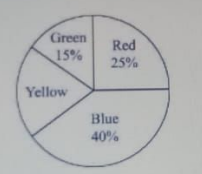
- A. 20
- B. 40
- C. 200
- D. 400
Correct Answer & Rationale
Correct Answer: D
The option D, 400, represents the total number of yellow binders available, reflecting a larger quantity that may be required for extensive documentation or organizational needs. Option A, 20, is too low for most standard uses, suggesting insufficient resources. Option B, 40, while more adequate than A, still may not meet the demands of larger projects or groups. Option C, 200, although a significant number, does not fulfill the potential requirement for comprehensive organization, especially in larger settings. Thus, option D ensures ample supply for diverse needs.
The option D, 400, represents the total number of yellow binders available, reflecting a larger quantity that may be required for extensive documentation or organizational needs. Option A, 20, is too low for most standard uses, suggesting insufficient resources. Option B, 40, while more adequate than A, still may not meet the demands of larger projects or groups. Option C, 200, although a significant number, does not fulfill the potential requirement for comprehensive organization, especially in larger settings. Thus, option D ensures ample supply for diverse needs.