Choose the best answer. If necessary, use the paper you were given.
During a sale, the regular price of a pair of running shoes is reduced by 20 percent. $64.00, what is the regular price of the running shoes?
- A. $48.00
- B. $51.20
- C. $76.80
- D. $80.00
Correct Answer & Rationale
Correct Answer: D
To find the regular price of the running shoes, we need to determine what amount, when reduced by 20%, equals $64.00. This can be calculated using the formula: Sale Price = Regular Price × (1 - Discount Rate). Here, the discount rate is 20%, or 0.20. Therefore, the equation becomes $64.00 = Regular Price × 0.80. Solving for Regular Price gives us $64.00 / 0.80 = $80.00. Option A ($48.00) is incorrect because it suggests a much larger discount than 20%. Option B ($51.20) miscalculates the reduction, indicating a 36% discount. Option C ($76.80) inaccurately reflects a smaller discount, resulting in an incorrect sale price. Thus, only option D correctly represents the regular price before the 20% reduction.
To find the regular price of the running shoes, we need to determine what amount, when reduced by 20%, equals $64.00. This can be calculated using the formula: Sale Price = Regular Price × (1 - Discount Rate). Here, the discount rate is 20%, or 0.20. Therefore, the equation becomes $64.00 = Regular Price × 0.80. Solving for Regular Price gives us $64.00 / 0.80 = $80.00. Option A ($48.00) is incorrect because it suggests a much larger discount than 20%. Option B ($51.20) miscalculates the reduction, indicating a 36% discount. Option C ($76.80) inaccurately reflects a smaller discount, resulting in an incorrect sale price. Thus, only option D correctly represents the regular price before the 20% reduction.
Other Related Questions
Which of the following is NOT a factor of x^4 +x^3?
- A. X
- B. X + 1
- C. X^3
- D. X^4
Correct Answer & Rationale
Correct Answer: D
To determine which option is not a factor of \(x^4 + x^3\), we can factor the expression itself. Factoring out the greatest common factor, we have \(x^3(x + 1)\). - **Option A: X** is a factor since \(x\) is part of \(x^3\). - **Option B: X + 1** is a factor as it is the remaining term after factoring \(x^3\). - **Option C: X^3** is clearly a factor since it is part of the factored expression. **Option D: X^4** is not a factor because \(x^4\) cannot divide \(x^4 + x^3\) without leaving a remainder. Thus, it does not fit into the factorization.
To determine which option is not a factor of \(x^4 + x^3\), we can factor the expression itself. Factoring out the greatest common factor, we have \(x^3(x + 1)\). - **Option A: X** is a factor since \(x\) is part of \(x^3\). - **Option B: X + 1** is a factor as it is the remaining term after factoring \(x^3\). - **Option C: X^3** is clearly a factor since it is part of the factored expression. **Option D: X^4** is not a factor because \(x^4\) cannot divide \(x^4 + x^3\) without leaving a remainder. Thus, it does not fit into the factorization.
Which equation is a correct way to calculate x?
- A. sin x=5,000 /7,000
- B. sin x= 7,000 /5,000
- C. tan x= 5,000/7,000
- D. tan x=7,000/5,000
Correct Answer & Rationale
Correct Answer: C
To solve for \( x \), the correct relationship involves the tangent function, as \( \tan \) is defined as the ratio of the opposite side to the adjacent side in a right triangle. Option C, \( \tan x = \frac{5,000}{7,000} \), accurately represents this ratio. Option A misapplies the sine function, which should represent the ratio of the opposite side to the hypotenuse, not the adjacent side. Similarly, option B incorrectly uses sine but with the sides reversed, leading to an inaccurate representation. Option D misuses tangent, suggesting the opposite and adjacent sides are swapped, which does not align with the definition of tangent. Thus, only option C correctly applies the tangent function to find \( x \).
To solve for \( x \), the correct relationship involves the tangent function, as \( \tan \) is defined as the ratio of the opposite side to the adjacent side in a right triangle. Option C, \( \tan x = \frac{5,000}{7,000} \), accurately represents this ratio. Option A misapplies the sine function, which should represent the ratio of the opposite side to the hypotenuse, not the adjacent side. Similarly, option B incorrectly uses sine but with the sides reversed, leading to an inaccurate representation. Option D misuses tangent, suggesting the opposite and adjacent sides are swapped, which does not align with the definition of tangent. Thus, only option C correctly applies the tangent function to find \( x \).
If a +√x= b then x =
- A. √b-√a
- B. √(b-1)
- C. (b-a)²
- D. b²-a²
Correct Answer & Rationale
Correct Answer: C
To solve for \( x \) in the equation \( a + \sqrt{x} = b \), we first isolate \( \sqrt{x} \) by rearranging the equation to \( \sqrt{x} = b - a \). Squaring both sides gives \( x = (b - a)^2 \), which corresponds to option C. Option A, \( \sqrt{b} - \sqrt{a} \), does not account for squaring the expression and thus cannot represent \( x \). Option B, \( \sqrt{(b-1)} \), is unrelated to the original equation and lacks the necessary operations. Option D, \( b^2 - a^2 \), applies the difference of squares incorrectly and does not solve for \( x \) directly.
To solve for \( x \) in the equation \( a + \sqrt{x} = b \), we first isolate \( \sqrt{x} \) by rearranging the equation to \( \sqrt{x} = b - a \). Squaring both sides gives \( x = (b - a)^2 \), which corresponds to option C. Option A, \( \sqrt{b} - \sqrt{a} \), does not account for squaring the expression and thus cannot represent \( x \). Option B, \( \sqrt{(b-1)} \), is unrelated to the original equation and lacks the necessary operations. Option D, \( b^2 - a^2 \), applies the difference of squares incorrectly and does not solve for \( x \) directly.
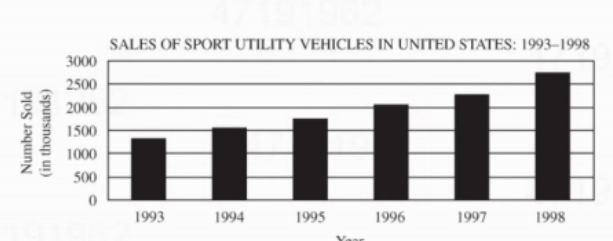
If the trend shown in the graph above continued into the next year, approximately how many sport utility vehicles were sold in 1999?
- A. 3 million
- B. 2.5 million
- C. 2 million
- D. 3 thousand
Correct Answer & Rationale
Correct Answer: A
To determine the approximate number of sport utility vehicles sold in 1999, analyzing the trend in the graph is essential. If the upward trend continued, sales would likely increase compared to previous years. Given the data, 3 million aligns with the projected growth rate, reflecting a significant rise consistent with market trends. Option B, 2.5 million, underestimates the growth, while C, 2 million, does not account for the upward trajectory. Option D, 3 thousand, is far too low and unrealistic, failing to represent the scale of SUV sales during that period. Thus, 3 million is the most reasonable estimate.
To determine the approximate number of sport utility vehicles sold in 1999, analyzing the trend in the graph is essential. If the upward trend continued, sales would likely increase compared to previous years. Given the data, 3 million aligns with the projected growth rate, reflecting a significant rise consistent with market trends. Option B, 2.5 million, underestimates the growth, while C, 2 million, does not account for the upward trajectory. Option D, 3 thousand, is far too low and unrealistic, failing to represent the scale of SUV sales during that period. Thus, 3 million is the most reasonable estimate.