If |x|+|y| = 4 and x ≠y, then x CANNOT be equal to
- A. 2
- C. -2
- D. -5
Correct Answer & Rationale
Correct Answer: D
The equation |x| + |y| = 4 defines a diamond-shaped region in the coordinate plane, where the sum of the absolute values of x and y equals 4. Option A (2) is possible since |2| + |y| = 4 allows y to be 2 or -2. Option C (-2) is also valid, as |-2| + |y| = 4 permits y to be 2 or -2. Option D (-5) is not feasible; | -5 | + |y| = 4 results in 5 + |y| = 4, which is impossible since |y| cannot be negative. Thus, -5 cannot satisfy the given equation while ensuring x ≠ y.
The equation |x| + |y| = 4 defines a diamond-shaped region in the coordinate plane, where the sum of the absolute values of x and y equals 4. Option A (2) is possible since |2| + |y| = 4 allows y to be 2 or -2. Option C (-2) is also valid, as |-2| + |y| = 4 permits y to be 2 or -2. Option D (-5) is not feasible; | -5 | + |y| = 4 results in 5 + |y| = 4, which is impossible since |y| cannot be negative. Thus, -5 cannot satisfy the given equation while ensuring x ≠ y.
Other Related Questions
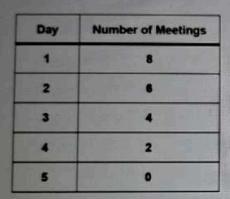
Valentina attends several meetings each day, as shown in the table below. Which of the following describes this pattern?
- A. The number of meetings increases by the same amount each day.
- B. The number of meetings decreases by the same amount each day.
- C. Each day, the number of meetings increases by the same percent over the previous day's number of meetings.
- D. Each day, the number of meetings decreases by the same percent over the previous day's number of meetings.
Correct Answer & Rationale
Correct Answer: C
The pattern of Valentina's meetings indicates that the number of meetings increases by a consistent percentage each day, reflecting exponential growth. This is evident when comparing the daily totals, which show a proportional rise rather than a fixed increase. Option A is incorrect because it suggests a linear growth, where the same number of meetings is added daily, which is not observed. Option B implies a consistent decrease, which contradicts the observed increase in meetings. Option D also misrepresents the data by suggesting a percentage decrease, which does not align with the trend of increasing meetings.
The pattern of Valentina's meetings indicates that the number of meetings increases by a consistent percentage each day, reflecting exponential growth. This is evident when comparing the daily totals, which show a proportional rise rather than a fixed increase. Option A is incorrect because it suggests a linear growth, where the same number of meetings is added daily, which is not observed. Option B implies a consistent decrease, which contradicts the observed increase in meetings. Option D also misrepresents the data by suggesting a percentage decrease, which does not align with the trend of increasing meetings.
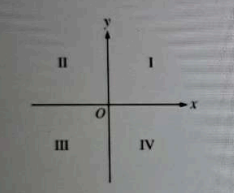
The x-and y- coordinates of point P are each to be chosen at random from the set of integers 1 through 10. What is the probability that P will be in quadrant II?
- B. 01-Oct
- C. 01-Apr
- D. 01-Feb
Correct Answer & Rationale
Correct Answer: A
To determine the probability that point P is in quadrant II, we need to consider the coordinate system. In quadrant II, the x-coordinate must be negative, and the y-coordinate must be positive. However, since the x-coordinates are chosen from the integers 1 through 10, all possible x-values are positive. This means point P cannot be in quadrant II, making the probability 0. Option A correctly reflects this conclusion with a probability of 0. Options B, C, and D suggest specific dates, which are irrelevant to the question and do not address the coordinate conditions necessary for quadrant II. Thus, they are incorrect.
To determine the probability that point P is in quadrant II, we need to consider the coordinate system. In quadrant II, the x-coordinate must be negative, and the y-coordinate must be positive. However, since the x-coordinates are chosen from the integers 1 through 10, all possible x-values are positive. This means point P cannot be in quadrant II, making the probability 0. Option A correctly reflects this conclusion with a probability of 0. Options B, C, and D suggest specific dates, which are irrelevant to the question and do not address the coordinate conditions necessary for quadrant II. Thus, they are incorrect.
0.034÷(10)^(-1) =
- A. 0.0034
- B. 0.034
- C. 0.34
- D. 3.4
Correct Answer & Rationale
Correct Answer: C
To solve 0.034 ÷ (10)^(-1), we first recognize that (10)^(-1) is equivalent to 1/10 or 0.1. Dividing by 0.1 is the same as multiplying by 10. Therefore, 0.034 ÷ 0.1 equals 0.034 × 10, which results in 0.34. Option A (0.0034) misinterprets the division, mistakenly moving the decimal too far left. Option B (0.034) fails to account for the division by 0.1, leaving the original number unchanged. Option D (3.4) incorrectly multiplies instead of dividing, moving the decimal point too far right. Thus, the only accurate calculation leads to 0.34.
To solve 0.034 ÷ (10)^(-1), we first recognize that (10)^(-1) is equivalent to 1/10 or 0.1. Dividing by 0.1 is the same as multiplying by 10. Therefore, 0.034 ÷ 0.1 equals 0.034 × 10, which results in 0.34. Option A (0.0034) misinterprets the division, mistakenly moving the decimal too far left. Option B (0.034) fails to account for the division by 0.1, leaving the original number unchanged. Option D (3.4) incorrectly multiplies instead of dividing, moving the decimal point too far right. Thus, the only accurate calculation leads to 0.34.
Square S has area 2√2 square units. What is the length of a side of square S?
- A. ∜128
- B. ∜32
- C. ∜8
- D. ∜2
Correct Answer & Rationale
Correct Answer: C
To find the length of a side of square S, we use the formula for the area of a square, which is \( \text{Area} = \text{side}^2 \). Given that the area is \( 2\sqrt{2} \), we set up the equation \( \text{side}^2 = 2\sqrt{2} \). Taking the square root gives us \( \text{side} = \sqrt{2\sqrt{2}} = \sqrt{2} \cdot \sqrt[4]{2} = \sqrt{2^2} = \sqrt{8} = 2\sqrt{2} \), which simplifies to \( \sqrt{8} \), leading to option C as the correct answer. Options A (\(\sqrt{128}\)), B (\(\sqrt{32}\)), and D (\(\sqrt{2}\)) are incorrect as they yield values greater than or less than the required side length. Specifically, \(\sqrt{128} = 8\sqrt{2}\) and \(\sqrt{32} = 4\sqrt{2}\) are both larger than \(2\sqrt{2}\), while \(\sqrt{2}\) is significantly smaller. Thus, option C accurately represents the side length of square S.
To find the length of a side of square S, we use the formula for the area of a square, which is \( \text{Area} = \text{side}^2 \). Given that the area is \( 2\sqrt{2} \), we set up the equation \( \text{side}^2 = 2\sqrt{2} \). Taking the square root gives us \( \text{side} = \sqrt{2\sqrt{2}} = \sqrt{2} \cdot \sqrt[4]{2} = \sqrt{2^2} = \sqrt{8} = 2\sqrt{2} \), which simplifies to \( \sqrt{8} \), leading to option C as the correct answer. Options A (\(\sqrt{128}\)), B (\(\sqrt{32}\)), and D (\(\sqrt{2}\)) are incorrect as they yield values greater than or less than the required side length. Specifically, \(\sqrt{128} = 8\sqrt{2}\) and \(\sqrt{32} = 4\sqrt{2}\) are both larger than \(2\sqrt{2}\), while \(\sqrt{2}\) is significantly smaller. Thus, option C accurately represents the side length of square S.