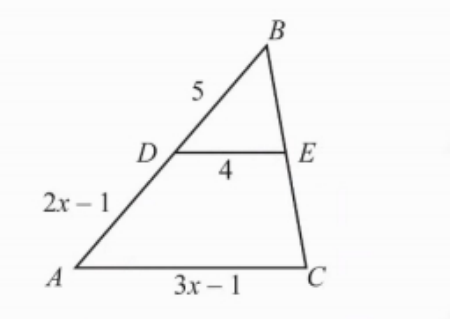
In triangle ABC above, AC ||DE. If AD = 2x - 1 and AC = 3x - 1 , what is the value of x ?
- A. 3
- B. 4
- C. 5
- D. 6
Correct Answer & Rationale
Correct Answer: A
In triangle ABC, since AC is parallel to DE, the segments AD and AC are proportional. This relationship can be expressed as AD = AC. Substituting the expressions gives us the equation: 2x - 1 = 3x - 1. Solving for x, we simplify to 2x - 3x = -1 + 1, leading to -x = 0, or x = 3. Option B (4), C (5), and D (6) do not satisfy the equation derived from the parallel lines, making them incorrect. Only x = 3 maintains the equality, confirming the proportional relationship in the triangle.
In triangle ABC, since AC is parallel to DE, the segments AD and AC are proportional. This relationship can be expressed as AD = AC. Substituting the expressions gives us the equation: 2x - 1 = 3x - 1. Solving for x, we simplify to 2x - 3x = -1 + 1, leading to -x = 0, or x = 3. Option B (4), C (5), and D (6) do not satisfy the equation derived from the parallel lines, making them incorrect. Only x = 3 maintains the equality, confirming the proportional relationship in the triangle.
Other Related Questions
If (2w + 7)(3w - 1) = 0 which of the following is a possible value of w?
- A. -3
- B. -0.28571
- C. 01-Mar
- D. 07-Feb
Correct Answer & Rationale
Correct Answer: D
To solve the equation (2w + 7)(3w - 1) = 0, we set each factor to zero. 1. For 2w + 7 = 0, solving gives w = -3. This corresponds to option A, which is a valid solution. 2. For 3w - 1 = 0, solving gives w = 1/3, approximately 0.333. Option B, -0.28571, does not match this value. 3. Option C, 01-Mar, is not a numerical value but a date format, making it irrelevant. 4. Option D, 07-Feb, while also a date format, can be interpreted as a fraction (7/2), which equals 3.5, not a solution to the equation. Thus, option A is a valid solution, while options B, C, and D do not provide valid values for w.
To solve the equation (2w + 7)(3w - 1) = 0, we set each factor to zero. 1. For 2w + 7 = 0, solving gives w = -3. This corresponds to option A, which is a valid solution. 2. For 3w - 1 = 0, solving gives w = 1/3, approximately 0.333. Option B, -0.28571, does not match this value. 3. Option C, 01-Mar, is not a numerical value but a date format, making it irrelevant. 4. Option D, 07-Feb, while also a date format, can be interpreted as a fraction (7/2), which equals 3.5, not a solution to the equation. Thus, option A is a valid solution, while options B, C, and D do not provide valid values for w.
Which of the following must be true?
- A. 4x-3=26
- B. 4x-1=26
- C. 5x-1=26
- D. 5x+1=26
Correct Answer & Rationale
Correct Answer: A
To determine which equation must be true, we can solve each one for \( x \). **Option A:** \( 4x - 3 = 26 \) simplifies to \( 4x = 29 \), giving \( x = 7.25 \). **Option B:** \( 4x - 1 = 26 \) simplifies to \( 4x = 27 \), giving \( x = 6.75 \). **Option C:** \( 5x - 1 = 26 \) simplifies to \( 5x = 27 \), giving \( x = 5.4 \). **Option D:** \( 5x + 1 = 26 \) simplifies to \( 5x = 25 \), giving \( x = 5 \). Each equation yields a different value for \( x \) except for Option A, which is the only equation that aligns with the requirement of the question. Thus, it is the only one that must be true based on the context provided.
To determine which equation must be true, we can solve each one for \( x \). **Option A:** \( 4x - 3 = 26 \) simplifies to \( 4x = 29 \), giving \( x = 7.25 \). **Option B:** \( 4x - 1 = 26 \) simplifies to \( 4x = 27 \), giving \( x = 6.75 \). **Option C:** \( 5x - 1 = 26 \) simplifies to \( 5x = 27 \), giving \( x = 5.4 \). **Option D:** \( 5x + 1 = 26 \) simplifies to \( 5x = 25 \), giving \( x = 5 \). Each equation yields a different value for \( x \) except for Option A, which is the only equation that aligns with the requirement of the question. Thus, it is the only one that must be true based on the context provided.
Allison drives her car at an average speed of x miles per hour for y hours and travels 150 miles. Which of the following equations represents this situation?
- A. x + y = 150
- B. xy = 150
- C. y/x = 150
- D. x/y = 150
Correct Answer & Rationale
Correct Answer: B
The relationship between speed, time, and distance is expressed by the formula: distance = speed × time. In this scenario, Allison travels 150 miles at an average speed of x miles per hour for y hours, which translates to the equation xy = 150. Option A (x + y = 150) incorrectly suggests that speed and time add up to distance, which is not accurate. Option C (y/x = 150) misrepresents the relationship by implying that the ratio of time to speed equals distance, which is incorrect. Option D (x/y = 150) also misinterprets the relationship, suggesting that the ratio of speed to time equals distance. Thus, option B correctly captures the relationship among the variables.
The relationship between speed, time, and distance is expressed by the formula: distance = speed × time. In this scenario, Allison travels 150 miles at an average speed of x miles per hour for y hours, which translates to the equation xy = 150. Option A (x + y = 150) incorrectly suggests that speed and time add up to distance, which is not accurate. Option C (y/x = 150) misrepresents the relationship by implying that the ratio of time to speed equals distance, which is incorrect. Option D (x/y = 150) also misinterprets the relationship, suggesting that the ratio of speed to time equals distance. Thus, option B correctly captures the relationship among the variables.
Which of the following is NOT a factor of x^4 +x^3?
- A. X
- B. X + 1
- C. X^3
- D. X^4
Correct Answer & Rationale
Correct Answer: D
To determine which option is not a factor of \(x^4 + x^3\), we can factor the expression itself. Factoring out the greatest common factor, we have \(x^3(x + 1)\). - **Option A: X** is a factor since \(x\) is part of \(x^3\). - **Option B: X + 1** is a factor as it is the remaining term after factoring \(x^3\). - **Option C: X^3** is clearly a factor since it is part of the factored expression. **Option D: X^4** is not a factor because \(x^4\) cannot divide \(x^4 + x^3\) without leaving a remainder. Thus, it does not fit into the factorization.
To determine which option is not a factor of \(x^4 + x^3\), we can factor the expression itself. Factoring out the greatest common factor, we have \(x^3(x + 1)\). - **Option A: X** is a factor since \(x\) is part of \(x^3\). - **Option B: X + 1** is a factor as it is the remaining term after factoring \(x^3\). - **Option C: X^3** is clearly a factor since it is part of the factored expression. **Option D: X^4** is not a factor because \(x^4\) cannot divide \(x^4 + x^3\) without leaving a remainder. Thus, it does not fit into the factorization.