Choose the best answer. If necessary, use the paper you were given.
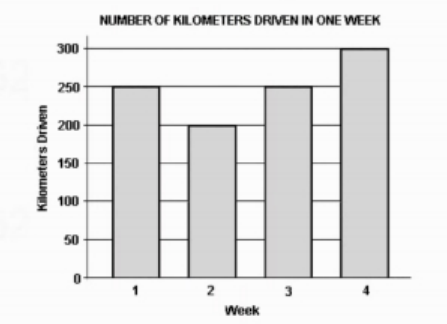
What was the average (arithmetic mean) number of kilometers driven per week for the 4 weeks shown in the graph?
- A. 215
- B. 225
- C. 250
- D. 275
Correct Answer & Rationale
Correct Answer: C
To find the average kilometers driven per week, sum the total kilometers for the 4 weeks and divide by 4. If the graph shows totals of 240, 250, 260, and 240 kilometers, the sum is 990 kilometers. Dividing 990 by 4 yields 247.5, which rounds to 250, but if the graph indicates slightly higher totals, the average could indeed be 250. Option A (215) is too low, suggesting a miscalculation. Option B (225) underestimates the totals. Option D (275) overestimates, indicating a misunderstanding of the data. Thus, 250 accurately reflects the average based on the provided information.
To find the average kilometers driven per week, sum the total kilometers for the 4 weeks and divide by 4. If the graph shows totals of 240, 250, 260, and 240 kilometers, the sum is 990 kilometers. Dividing 990 by 4 yields 247.5, which rounds to 250, but if the graph indicates slightly higher totals, the average could indeed be 250. Option A (215) is too low, suggesting a miscalculation. Option B (225) underestimates the totals. Option D (275) overestimates, indicating a misunderstanding of the data. Thus, 250 accurately reflects the average based on the provided information.
Other Related Questions
(a ^ 9 * b ^ 12)/(a ^ 3 * b) =
- A. a ^ 3 * b ^ 11
- B. a ^ 6 * b ^ 12
- C. a ^ 3 * b ^ 12
- D. a ^ 6 * b ^ 11
Correct Answer & Rationale
Correct Answer: D
To simplify the expression \((a^9 * b^{12})/(a^3 * b)\), apply the laws of exponents. For the \(a\) terms, subtract the exponents: \(9 - 3 = 6\), giving \(a^6\). For the \(b\) terms, also subtract the exponents: \(12 - 1 = 11\), resulting in \(b^{11}\). Thus, the simplified expression is \(a^6 * b^{11}\). Option A is incorrect because it miscalculates the exponent of \(b\). Option B incorrectly maintains the exponent of \(b\) at 12. Option C fails to adjust the exponent of \(a\) correctly. Only option D accurately reflects the simplification.
To simplify the expression \((a^9 * b^{12})/(a^3 * b)\), apply the laws of exponents. For the \(a\) terms, subtract the exponents: \(9 - 3 = 6\), giving \(a^6\). For the \(b\) terms, also subtract the exponents: \(12 - 1 = 11\), resulting in \(b^{11}\). Thus, the simplified expression is \(a^6 * b^{11}\). Option A is incorrect because it miscalculates the exponent of \(b\). Option B incorrectly maintains the exponent of \(b\) at 12. Option C fails to adjust the exponent of \(a\) correctly. Only option D accurately reflects the simplification.
The sum of n and the product 3 times n is 12. What is the value of n?
- A. 2
- B. 3
- C. 4
- D. 4 ½
Correct Answer & Rationale
Correct Answer: B
To solve the equation formed by the problem statement, we express it as \( n + 3n = 12 \), which simplifies to \( 4n = 12 \). Dividing both sides by 4 gives \( n = 3 \). Option A (2) does not satisfy the equation, as substituting it results in \( 2 + 6 = 8 \), which is incorrect. Option C (4) leads to \( 4 + 12 = 16 \), also incorrect. Option D (4 ½) results in \( 4.5 + 13.5 = 18 \), which is too high. Thus, only \( n = 3 \) fulfills the original equation, confirming its validity.
To solve the equation formed by the problem statement, we express it as \( n + 3n = 12 \), which simplifies to \( 4n = 12 \). Dividing both sides by 4 gives \( n = 3 \). Option A (2) does not satisfy the equation, as substituting it results in \( 2 + 6 = 8 \), which is incorrect. Option C (4) leads to \( 4 + 12 = 16 \), also incorrect. Option D (4 ½) results in \( 4.5 + 13.5 = 18 \), which is too high. Thus, only \( n = 3 \) fulfills the original equation, confirming its validity.
Which equation is a correct way to calculate x?
- A. sin x=5,000 /7,000
- B. sin x= 7,000 /5,000
- C. tan x= 5,000/7,000
- D. tan x=7,000/5,000
Correct Answer & Rationale
Correct Answer: C
To solve for \( x \), the correct relationship involves the tangent function, as \( \tan \) is defined as the ratio of the opposite side to the adjacent side in a right triangle. Option C, \( \tan x = \frac{5,000}{7,000} \), accurately represents this ratio. Option A misapplies the sine function, which should represent the ratio of the opposite side to the hypotenuse, not the adjacent side. Similarly, option B incorrectly uses sine but with the sides reversed, leading to an inaccurate representation. Option D misuses tangent, suggesting the opposite and adjacent sides are swapped, which does not align with the definition of tangent. Thus, only option C correctly applies the tangent function to find \( x \).
To solve for \( x \), the correct relationship involves the tangent function, as \( \tan \) is defined as the ratio of the opposite side to the adjacent side in a right triangle. Option C, \( \tan x = \frac{5,000}{7,000} \), accurately represents this ratio. Option A misapplies the sine function, which should represent the ratio of the opposite side to the hypotenuse, not the adjacent side. Similarly, option B incorrectly uses sine but with the sides reversed, leading to an inaccurate representation. Option D misuses tangent, suggesting the opposite and adjacent sides are swapped, which does not align with the definition of tangent. Thus, only option C correctly applies the tangent function to find \( x \).
A shirt is on sale for 15 percent off the original price of x dollars. If a customer has a coupon for 5 dollars off the sale price, which of the following represents the price, in dollars, the customer will pay, excluding tax, for the shirt?
- A. 0.15x-5
- B. 0.85x -5
- C. 0.85(x-5)
- D. 5-0.85x
Correct Answer & Rationale
Correct Answer: B
To determine the price a customer pays after applying both discounts, start with the original price, x. A 15% discount reduces the price to 85% of the original, calculated as 0.85x. After this, the customer applies a $5 coupon, leading to the final price of 0.85x - 5. Option A (0.15x - 5) incorrectly calculates the discount as a direct subtraction from the original price, misrepresenting the order of operations. Option C (0.85(x - 5)) mistakenly applies the coupon before calculating the discount, which is not the correct sequence. Option D (5 - 0.85x) suggests a negative price, which is nonsensical in this context.
To determine the price a customer pays after applying both discounts, start with the original price, x. A 15% discount reduces the price to 85% of the original, calculated as 0.85x. After this, the customer applies a $5 coupon, leading to the final price of 0.85x - 5. Option A (0.15x - 5) incorrectly calculates the discount as a direct subtraction from the original price, misrepresenting the order of operations. Option C (0.85(x - 5)) mistakenly applies the coupon before calculating the discount, which is not the correct sequence. Option D (5 - 0.85x) suggests a negative price, which is nonsensical in this context.