If the combined amount of donations collected by Kevin, Fran, and Brooke exceeded the amount Lamar collected by $250, what was the total amount of donations collected by all five club members?
- A. $500
- B. $1,200
- C. $2,500
- D. $3,200
Correct Answer & Rationale
Correct Answer: C
To determine the total amount of donations collected by all five club members, we start with the information that the combined donations of Kevin, Fran, and Brooke exceeded Lamar's by $250. If we denote Lamar's donations as \( L \), then the amount collected by Kevin, Fran, and Brooke is \( L + 250 \). Thus, the total donations from all five members can be expressed as \( L + (L + 250) = 2L + 250 \). To find a plausible total, we consider the options. - A: $500 is too low, as it doesn't allow for both \( L \) and the excess amount. - B: $1,200 also falls short since it would imply \( L \) is negative. - D: $3,200 would require \( L \) to be too high, exceeding reasonable donation limits. C: $2,500 fits perfectly, allowing \( L \) to be $1,125, which is a feasible figure. Therefore, the total amount is logically $2,500.
To determine the total amount of donations collected by all five club members, we start with the information that the combined donations of Kevin, Fran, and Brooke exceeded Lamar's by $250. If we denote Lamar's donations as \( L \), then the amount collected by Kevin, Fran, and Brooke is \( L + 250 \). Thus, the total donations from all five members can be expressed as \( L + (L + 250) = 2L + 250 \). To find a plausible total, we consider the options. - A: $500 is too low, as it doesn't allow for both \( L \) and the excess amount. - B: $1,200 also falls short since it would imply \( L \) is negative. - D: $3,200 would require \( L \) to be too high, exceeding reasonable donation limits. C: $2,500 fits perfectly, allowing \( L \) to be $1,125, which is a feasible figure. Therefore, the total amount is logically $2,500.
Other Related Questions
Which of the following could be the function graphed above?
- A. f(x)=x+1
- B. f(x)=x-1
- C. f(x)=|x|+1
- D. f(x)=x-1
Correct Answer & Rationale
Correct Answer: C
Option C, \( f(x) = |x| + 1 \), accurately represents a V-shaped graph that opens upwards, with its vertex at (0, 1). This aligns with the characteristics of the graph shown. Option A, \( f(x) = x + 1 \), is a linear function with a slope of 1, resulting in a straight line, which does not match the V-shape. Option B, \( f(x) = x - 1 \), is another linear function with a slope of 1, also producing a straight line that does not fit the graph. Option D, \( f(x) = x - 1 \), is identical to Option B and shares the same linear characteristics, further confirming it cannot represent the V-shaped graph.
Option C, \( f(x) = |x| + 1 \), accurately represents a V-shaped graph that opens upwards, with its vertex at (0, 1). This aligns with the characteristics of the graph shown. Option A, \( f(x) = x + 1 \), is a linear function with a slope of 1, resulting in a straight line, which does not match the V-shape. Option B, \( f(x) = x - 1 \), is another linear function with a slope of 1, also producing a straight line that does not fit the graph. Option D, \( f(x) = x - 1 \), is identical to Option B and shares the same linear characteristics, further confirming it cannot represent the V-shaped graph.
(a ^ 9 * b ^ 12)/(a ^ 3 * b) =
- A. a ^ 3 * b ^ 11
- B. a ^ 6 * b ^ 12
- C. a ^ 3 * b ^ 12
- D. a ^ 6 * b ^ 11
Correct Answer & Rationale
Correct Answer: D
To simplify the expression \((a^9 * b^{12})/(a^3 * b)\), apply the laws of exponents. For the \(a\) terms, subtract the exponents: \(9 - 3 = 6\), giving \(a^6\). For the \(b\) terms, also subtract the exponents: \(12 - 1 = 11\), resulting in \(b^{11}\). Thus, the simplified expression is \(a^6 * b^{11}\). Option A is incorrect because it miscalculates the exponent of \(b\). Option B incorrectly maintains the exponent of \(b\) at 12. Option C fails to adjust the exponent of \(a\) correctly. Only option D accurately reflects the simplification.
To simplify the expression \((a^9 * b^{12})/(a^3 * b)\), apply the laws of exponents. For the \(a\) terms, subtract the exponents: \(9 - 3 = 6\), giving \(a^6\). For the \(b\) terms, also subtract the exponents: \(12 - 1 = 11\), resulting in \(b^{11}\). Thus, the simplified expression is \(a^6 * b^{11}\). Option A is incorrect because it miscalculates the exponent of \(b\). Option B incorrectly maintains the exponent of \(b\) at 12. Option C fails to adjust the exponent of \(a\) correctly. Only option D accurately reflects the simplification.
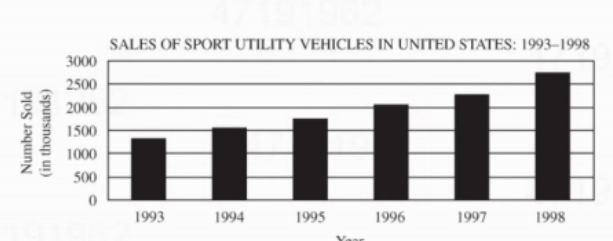
If the trend shown in the graph above continued into the next year, approximately how many sport utility vehicles were sold in 1999?
- A. 3 million
- B. 2.5 million
- C. 2 million
- D. 3 thousand
Correct Answer & Rationale
Correct Answer: A
To determine the approximate number of sport utility vehicles sold in 1999, analyzing the trend in the graph is essential. If the upward trend continued, sales would likely increase compared to previous years. Given the data, 3 million aligns with the projected growth rate, reflecting a significant rise consistent with market trends. Option B, 2.5 million, underestimates the growth, while C, 2 million, does not account for the upward trajectory. Option D, 3 thousand, is far too low and unrealistic, failing to represent the scale of SUV sales during that period. Thus, 3 million is the most reasonable estimate.
To determine the approximate number of sport utility vehicles sold in 1999, analyzing the trend in the graph is essential. If the upward trend continued, sales would likely increase compared to previous years. Given the data, 3 million aligns with the projected growth rate, reflecting a significant rise consistent with market trends. Option B, 2.5 million, underestimates the growth, while C, 2 million, does not account for the upward trajectory. Option D, 3 thousand, is far too low and unrealistic, failing to represent the scale of SUV sales during that period. Thus, 3 million is the most reasonable estimate.
Which of the following is NOT a factor of x^4 +x^3?
- A. X
- B. X + 1
- C. X^3
- D. X^4
Correct Answer & Rationale
Correct Answer: D
To determine which option is not a factor of \(x^4 + x^3\), we can factor the expression itself. Factoring out the greatest common factor, we have \(x^3(x + 1)\). - **Option A: X** is a factor since \(x\) is part of \(x^3\). - **Option B: X + 1** is a factor as it is the remaining term after factoring \(x^3\). - **Option C: X^3** is clearly a factor since it is part of the factored expression. **Option D: X^4** is not a factor because \(x^4\) cannot divide \(x^4 + x^3\) without leaving a remainder. Thus, it does not fit into the factorization.
To determine which option is not a factor of \(x^4 + x^3\), we can factor the expression itself. Factoring out the greatest common factor, we have \(x^3(x + 1)\). - **Option A: X** is a factor since \(x\) is part of \(x^3\). - **Option B: X + 1** is a factor as it is the remaining term after factoring \(x^3\). - **Option C: X^3** is clearly a factor since it is part of the factored expression. **Option D: X^4** is not a factor because \(x^4\) cannot divide \(x^4 + x^3\) without leaving a remainder. Thus, it does not fit into the factorization.