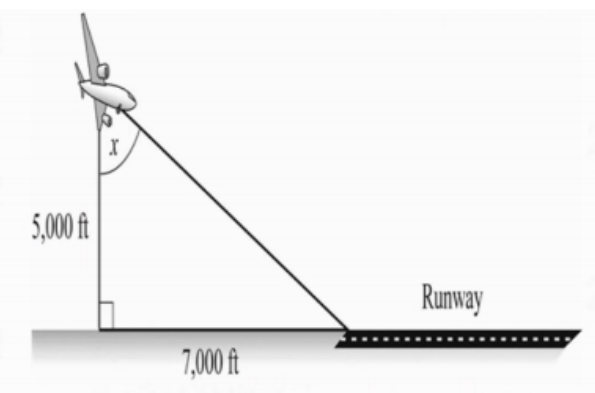
An airplane is 5,000 ft above ground and has to land on a runway that is 7,000 ft away as shown above. Let x be the angle the pilot takes to land the airplane at the beginning of the runway. Which equation is a correct way to calculate x?
- A. sin x = 5000/7000
- B. sin x = 7000/5000
- C. tan x = 5000/7000
- D. tan x = 7/5000
Correct Answer & Rationale
Correct Answer: C
To determine the angle \( x \) for landing, we need to consider the relationship between the height of the airplane and the distance to the runway. The height (5000 ft) is the opposite side of the right triangle formed, while the distance to the runway (7000 ft) is the adjacent side. The tangent function relates these two sides, hence \( \tan x = \frac{\text{opposite}}{\text{adjacent}} \) leads to \( \tan x = \frac{5000}{7000} \). Option A incorrectly uses the sine function, which relates the opposite side to the hypotenuse. Option B also misapplies sine but swaps the sides, leading to an incorrect ratio. Option D incorrectly uses tangent but misrepresents the sides, making it invalid. Thus, option C accurately represents the relationship needed to calculate angle \( x \).
To determine the angle \( x \) for landing, we need to consider the relationship between the height of the airplane and the distance to the runway. The height (5000 ft) is the opposite side of the right triangle formed, while the distance to the runway (7000 ft) is the adjacent side. The tangent function relates these two sides, hence \( \tan x = \frac{\text{opposite}}{\text{adjacent}} \) leads to \( \tan x = \frac{5000}{7000} \). Option A incorrectly uses the sine function, which relates the opposite side to the hypotenuse. Option B also misapplies sine but swaps the sides, leading to an incorrect ratio. Option D incorrectly uses tangent but misrepresents the sides, making it invalid. Thus, option C accurately represents the relationship needed to calculate angle \( x \).
Other Related Questions
A shirt is on sale for 15 percent off the original price of x dollars. If a customer has a coupon for 5 dollars off the sale price, which of the following represents the price, in dollars, the customer will pay, excluding tax, for the shirt?
- A. 0.15x-5
- B. 0.85x -5
- C. 0.85(x-5)
- D. 5-0.85x
Correct Answer & Rationale
Correct Answer: B
To determine the price a customer pays after applying both discounts, start with the original price, x. A 15% discount reduces the price to 85% of the original, calculated as 0.85x. After this, the customer applies a $5 coupon, leading to the final price of 0.85x - 5. Option A (0.15x - 5) incorrectly calculates the discount as a direct subtraction from the original price, misrepresenting the order of operations. Option C (0.85(x - 5)) mistakenly applies the coupon before calculating the discount, which is not the correct sequence. Option D (5 - 0.85x) suggests a negative price, which is nonsensical in this context.
To determine the price a customer pays after applying both discounts, start with the original price, x. A 15% discount reduces the price to 85% of the original, calculated as 0.85x. After this, the customer applies a $5 coupon, leading to the final price of 0.85x - 5. Option A (0.15x - 5) incorrectly calculates the discount as a direct subtraction from the original price, misrepresenting the order of operations. Option C (0.85(x - 5)) mistakenly applies the coupon before calculating the discount, which is not the correct sequence. Option D (5 - 0.85x) suggests a negative price, which is nonsensical in this context.
The sum of n and the product 3 times n is 12. What is the value of n?
- A. 2
- B. 3
- C. 4
- D. 4 ½
Correct Answer & Rationale
Correct Answer: B
To solve the equation formed by the problem statement, we express it as \( n + 3n = 12 \), which simplifies to \( 4n = 12 \). Dividing both sides by 4 gives \( n = 3 \). Option A (2) does not satisfy the equation, as substituting it results in \( 2 + 6 = 8 \), which is incorrect. Option C (4) leads to \( 4 + 12 = 16 \), also incorrect. Option D (4 ½) results in \( 4.5 + 13.5 = 18 \), which is too high. Thus, only \( n = 3 \) fulfills the original equation, confirming its validity.
To solve the equation formed by the problem statement, we express it as \( n + 3n = 12 \), which simplifies to \( 4n = 12 \). Dividing both sides by 4 gives \( n = 3 \). Option A (2) does not satisfy the equation, as substituting it results in \( 2 + 6 = 8 \), which is incorrect. Option C (4) leads to \( 4 + 12 = 16 \), also incorrect. Option D (4 ½) results in \( 4.5 + 13.5 = 18 \), which is too high. Thus, only \( n = 3 \) fulfills the original equation, confirming its validity.
If the combined amount of donations collected by Kevin, Fran, and Brooke exceeded the amount Lamar collected by $250, what was the total amount of donations collected by all five club members?
- A. $500
- B. $1,200
- C. $2,500
- D. $3,200
Correct Answer & Rationale
Correct Answer: C
To determine the total amount of donations collected by all five club members, we start with the information that the combined donations of Kevin, Fran, and Brooke exceeded Lamar's by $250. If we denote Lamar's donations as \( L \), then the amount collected by Kevin, Fran, and Brooke is \( L + 250 \). Thus, the total donations from all five members can be expressed as \( L + (L + 250) = 2L + 250 \). To find a plausible total, we consider the options. - A: $500 is too low, as it doesn't allow for both \( L \) and the excess amount. - B: $1,200 also falls short since it would imply \( L \) is negative. - D: $3,200 would require \( L \) to be too high, exceeding reasonable donation limits. C: $2,500 fits perfectly, allowing \( L \) to be $1,125, which is a feasible figure. Therefore, the total amount is logically $2,500.
To determine the total amount of donations collected by all five club members, we start with the information that the combined donations of Kevin, Fran, and Brooke exceeded Lamar's by $250. If we denote Lamar's donations as \( L \), then the amount collected by Kevin, Fran, and Brooke is \( L + 250 \). Thus, the total donations from all five members can be expressed as \( L + (L + 250) = 2L + 250 \). To find a plausible total, we consider the options. - A: $500 is too low, as it doesn't allow for both \( L \) and the excess amount. - B: $1,200 also falls short since it would imply \( L \) is negative. - D: $3,200 would require \( L \) to be too high, exceeding reasonable donation limits. C: $2,500 fits perfectly, allowing \( L \) to be $1,125, which is a feasible figure. Therefore, the total amount is logically $2,500.
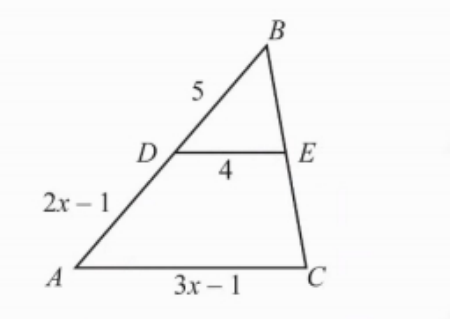
In triangle ABC above, AC ||DE. If AD = 2x - 1 and AC = 3x - 1 , what is the value of x ?
- A. 3
- B. 4
- C. 5
- D. 6
Correct Answer & Rationale
Correct Answer: A
In triangle ABC, since AC is parallel to DE, the segments AD and AC are proportional. This relationship can be expressed as AD = AC. Substituting the expressions gives us the equation: 2x - 1 = 3x - 1. Solving for x, we simplify to 2x - 3x = -1 + 1, leading to -x = 0, or x = 3. Option B (4), C (5), and D (6) do not satisfy the equation derived from the parallel lines, making them incorrect. Only x = 3 maintains the equality, confirming the proportional relationship in the triangle.
In triangle ABC, since AC is parallel to DE, the segments AD and AC are proportional. This relationship can be expressed as AD = AC. Substituting the expressions gives us the equation: 2x - 1 = 3x - 1. Solving for x, we simplify to 2x - 3x = -1 + 1, leading to -x = 0, or x = 3. Option B (4), C (5), and D (6) do not satisfy the equation derived from the parallel lines, making them incorrect. Only x = 3 maintains the equality, confirming the proportional relationship in the triangle.