Choose the best answer. If necessary, use the paper you were given.
Doreen bought a dress priced at $89 and a skirt priced at $36. She paid a total of $135 for the dress and the skirt, including sales tax. What was the sales tax rate?
- A. 6%
- B. 7%
- C. 8%
- D. 9%
Correct Answer & Rationale
Correct Answer: C
To determine the sales tax rate, first calculate the total cost of the dress and skirt without tax: $89 + $36 = $125. Doreen paid $135, which means the sales tax was $135 - $125 = $10. To find the sales tax rate, divide the tax amount by the pre-tax total: $10 / $125 = 0.08, or 8%. Option A (6%) is incorrect as it would result in a lower tax amount. Option B (7%) also yields a tax amount that is too low. Option D (9%) would produce a tax amount exceeding $10, making it incorrect. Thus, the only option that accurately reflects the calculated sales tax rate is 8%.
To determine the sales tax rate, first calculate the total cost of the dress and skirt without tax: $89 + $36 = $125. Doreen paid $135, which means the sales tax was $135 - $125 = $10. To find the sales tax rate, divide the tax amount by the pre-tax total: $10 / $125 = 0.08, or 8%. Option A (6%) is incorrect as it would result in a lower tax amount. Option B (7%) also yields a tax amount that is too low. Option D (9%) would produce a tax amount exceeding $10, making it incorrect. Thus, the only option that accurately reflects the calculated sales tax rate is 8%.
Other Related Questions
The expressions x - 2 and x + 3 represent the length and width of a rectangle, respectively. If the area of the rectangle is 24, what is the perimeter of the rectangle?
- A. 20
- B. 22
- C. 24
- D. 28
Correct Answer & Rationale
Correct Answer: B
To find the perimeter of the rectangle, first calculate its dimensions using the area formula. The area is given by multiplying length and width: \[ (x - 2)(x + 3) = 24 \] Expanding this, we get: \[ x^2 + x - 6 = 24 \implies x^2 + x - 30 = 0 \] Factoring yields: \[ (x - 5)(x + 6) = 0 \implies x = 5 \text{ (valid)} \text{ or } x = -6 \text{ (not valid)} \] Using \(x = 5\), the dimensions are \(3\) (length) and \(8\) (width). The perimeter is: \[ 2(3 + 8) = 22 \] Options A (20), C (24), and D (28) do not match the calculated perimeter of 22, confirming they are incorrect.
To find the perimeter of the rectangle, first calculate its dimensions using the area formula. The area is given by multiplying length and width: \[ (x - 2)(x + 3) = 24 \] Expanding this, we get: \[ x^2 + x - 6 = 24 \implies x^2 + x - 30 = 0 \] Factoring yields: \[ (x - 5)(x + 6) = 0 \implies x = 5 \text{ (valid)} \text{ or } x = -6 \text{ (not valid)} \] Using \(x = 5\), the dimensions are \(3\) (length) and \(8\) (width). The perimeter is: \[ 2(3 + 8) = 22 \] Options A (20), C (24), and D (28) do not match the calculated perimeter of 22, confirming they are incorrect.
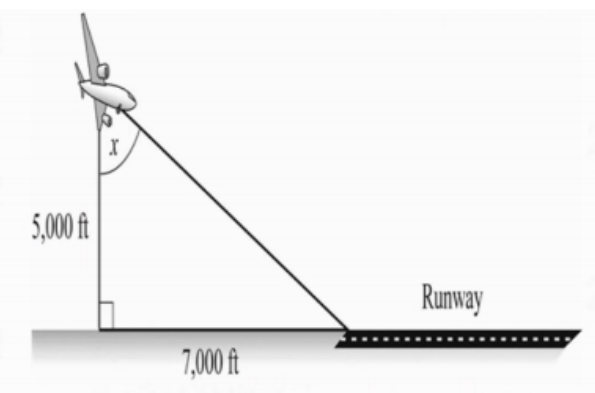
An airplane is 5,000 ft above ground and has to land on a runway that is 7,000 ft away as shown above. Let x be the angle the pilot takes to land the airplane at the beginning of the runway. Which equation is a correct way to calculate x?
- A. sin x = 5000/7000
- B. sin x = 7000/5000
- C. tan x = 5000/7000
- D. tan x = 7/5000
Correct Answer & Rationale
Correct Answer: C
To determine the angle \( x \) for landing, we need to consider the relationship between the height of the airplane and the distance to the runway. The height (5000 ft) is the opposite side of the right triangle formed, while the distance to the runway (7000 ft) is the adjacent side. The tangent function relates these two sides, hence \( \tan x = \frac{\text{opposite}}{\text{adjacent}} \) leads to \( \tan x = \frac{5000}{7000} \). Option A incorrectly uses the sine function, which relates the opposite side to the hypotenuse. Option B also misapplies sine but swaps the sides, leading to an incorrect ratio. Option D incorrectly uses tangent but misrepresents the sides, making it invalid. Thus, option C accurately represents the relationship needed to calculate angle \( x \).
To determine the angle \( x \) for landing, we need to consider the relationship between the height of the airplane and the distance to the runway. The height (5000 ft) is the opposite side of the right triangle formed, while the distance to the runway (7000 ft) is the adjacent side. The tangent function relates these two sides, hence \( \tan x = \frac{\text{opposite}}{\text{adjacent}} \) leads to \( \tan x = \frac{5000}{7000} \). Option A incorrectly uses the sine function, which relates the opposite side to the hypotenuse. Option B also misapplies sine but swaps the sides, leading to an incorrect ratio. Option D incorrectly uses tangent but misrepresents the sides, making it invalid. Thus, option C accurately represents the relationship needed to calculate angle \( x \).
If the function g is defined by g (x) = x/(x+1)', which of the following is true?
- A. g (10) <g (20)
- B. g (20) <g (10)
- C. g(0) =1
- D. g(1)=0
Correct Answer & Rationale
Correct Answer: A
To analyze the function \( g(x) = \frac{x}{x+1} \), we first observe its behavior as \( x \) increases. The function \( g(x) \) is a rational function that approaches 1 as \( x \) approaches infinity. For option A, evaluating \( g(10) \) and \( g(20) \): - \( g(10) = \frac{10}{11} \approx 0.909 \) - \( g(20) = \frac{20}{21} \approx 0.952 \) Since \( 0.909 < 0.952 \), option A is true. For option B, it incorrectly suggests \( g(20) < g(10) \), which contradicts the findings. Option C states \( g(0) = 1 \), but \( g(0) = 0 \), making this option false. Option D claims \( g(1) = 0 \), while \( g(1) = \frac{1}{2} \), which is also incorrect. Thus, only option A holds true.
To analyze the function \( g(x) = \frac{x}{x+1} \), we first observe its behavior as \( x \) increases. The function \( g(x) \) is a rational function that approaches 1 as \( x \) approaches infinity. For option A, evaluating \( g(10) \) and \( g(20) \): - \( g(10) = \frac{10}{11} \approx 0.909 \) - \( g(20) = \frac{20}{21} \approx 0.952 \) Since \( 0.909 < 0.952 \), option A is true. For option B, it incorrectly suggests \( g(20) < g(10) \), which contradicts the findings. Option C states \( g(0) = 1 \), but \( g(0) = 0 \), making this option false. Option D claims \( g(1) = 0 \), while \( g(1) = \frac{1}{2} \), which is also incorrect. Thus, only option A holds true.
If (2w + 7)(3w - 1) = 0 which of the following is a possible value of w?
- A. -3
- B. -0.28571
- C. 01-Mar
- D. 07-Feb
Correct Answer & Rationale
Correct Answer: D
To solve the equation (2w + 7)(3w - 1) = 0, we set each factor to zero. 1. For 2w + 7 = 0, solving gives w = -3. This corresponds to option A, which is a valid solution. 2. For 3w - 1 = 0, solving gives w = 1/3, approximately 0.333. Option B, -0.28571, does not match this value. 3. Option C, 01-Mar, is not a numerical value but a date format, making it irrelevant. 4. Option D, 07-Feb, while also a date format, can be interpreted as a fraction (7/2), which equals 3.5, not a solution to the equation. Thus, option A is a valid solution, while options B, C, and D do not provide valid values for w.
To solve the equation (2w + 7)(3w - 1) = 0, we set each factor to zero. 1. For 2w + 7 = 0, solving gives w = -3. This corresponds to option A, which is a valid solution. 2. For 3w - 1 = 0, solving gives w = 1/3, approximately 0.333. Option B, -0.28571, does not match this value. 3. Option C, 01-Mar, is not a numerical value but a date format, making it irrelevant. 4. Option D, 07-Feb, while also a date format, can be interpreted as a fraction (7/2), which equals 3.5, not a solution to the equation. Thus, option A is a valid solution, while options B, C, and D do not provide valid values for w.