Choose the best answer. If necessary, use the paper you were given.
The average of 5 numbers is 11. Which of the following must be true?
- A. The range of the 5 numbers is 55.
- B. The sum of the 5 numbers is 55.
- C. The median of 5 numbers is 11.
- D. The mode of 5 numbers is 11.
Correct Answer & Rationale
Correct Answer: B
To find the average of 5 numbers, you sum them and divide by 5. If the average is 11, the total sum must be 5 times 11, which equals 55. Thus, option B is true. Option A is incorrect; the range is the difference between the highest and lowest numbers, which can vary regardless of the average. Option C is also not necessarily true; the median, or middle value, can differ from the average depending on the distribution of the numbers. Option D is incorrect; the mode, or most frequently occurring number, does not have to be the same as the average.
To find the average of 5 numbers, you sum them and divide by 5. If the average is 11, the total sum must be 5 times 11, which equals 55. Thus, option B is true. Option A is incorrect; the range is the difference between the highest and lowest numbers, which can vary regardless of the average. Option C is also not necessarily true; the median, or middle value, can differ from the average depending on the distribution of the numbers. Option D is incorrect; the mode, or most frequently occurring number, does not have to be the same as the average.
Other Related Questions
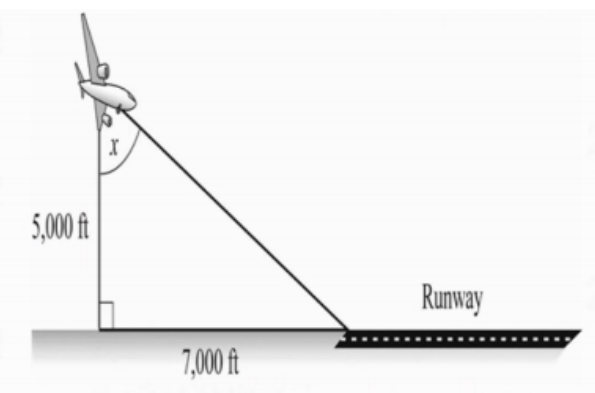
An airplane is 5,000 ft above ground and has to land on a runway that is 7,000 ft away as shown above. Let x be the angle the pilot takes to land the airplane at the beginning of the runway. Which equation is a correct way to calculate x?
- A. sin x = 5000/7000
- B. sin x = 7000/5000
- C. tan x = 5000/7000
- D. tan x = 7/5000
Correct Answer & Rationale
Correct Answer: C
To determine the angle \( x \) for landing, we need to consider the relationship between the height of the airplane and the distance to the runway. The height (5000 ft) is the opposite side of the right triangle formed, while the distance to the runway (7000 ft) is the adjacent side. The tangent function relates these two sides, hence \( \tan x = \frac{\text{opposite}}{\text{adjacent}} \) leads to \( \tan x = \frac{5000}{7000} \). Option A incorrectly uses the sine function, which relates the opposite side to the hypotenuse. Option B also misapplies sine but swaps the sides, leading to an incorrect ratio. Option D incorrectly uses tangent but misrepresents the sides, making it invalid. Thus, option C accurately represents the relationship needed to calculate angle \( x \).
To determine the angle \( x \) for landing, we need to consider the relationship between the height of the airplane and the distance to the runway. The height (5000 ft) is the opposite side of the right triangle formed, while the distance to the runway (7000 ft) is the adjacent side. The tangent function relates these two sides, hence \( \tan x = \frac{\text{opposite}}{\text{adjacent}} \) leads to \( \tan x = \frac{5000}{7000} \). Option A incorrectly uses the sine function, which relates the opposite side to the hypotenuse. Option B also misapplies sine but swaps the sides, leading to an incorrect ratio. Option D incorrectly uses tangent but misrepresents the sides, making it invalid. Thus, option C accurately represents the relationship needed to calculate angle \( x \).
For what values of x does 5x ^ 2 + 4x - 4 = 0 ?
- A. x = 1/5 and x = - 1
- B. x = - 4/5 and x = 1
- C. x = (- 2±6 * √(2))/5
- D. x = (- 2±2 * √(6))/5
Correct Answer & Rationale
Correct Answer: D
To solve the quadratic equation \(5x^2 + 4x - 4 = 0\), one can apply the quadratic formula \(x = \frac{-b \pm \sqrt{b^2 - 4ac}}{2a}\). Here, \(a = 5\), \(b = 4\), and \(c = -4\). Calculating the discriminant gives \(b^2 - 4ac = 16 + 80 = 96\), leading to \(x = \frac{-4 \pm \sqrt{96}}{10} = \frac{-4 \pm 4\sqrt{6}}{10} = \frac{-2 \pm 2\sqrt{6}}{5}\), which matches option D. Option A provides incorrect roots not derived from the quadratic formula. Option B also presents incorrect values, failing to satisfy the equation. Option C miscalculates the discriminant, leading to an incorrect expression. Thus, D accurately reflects the solution to the equation.
To solve the quadratic equation \(5x^2 + 4x - 4 = 0\), one can apply the quadratic formula \(x = \frac{-b \pm \sqrt{b^2 - 4ac}}{2a}\). Here, \(a = 5\), \(b = 4\), and \(c = -4\). Calculating the discriminant gives \(b^2 - 4ac = 16 + 80 = 96\), leading to \(x = \frac{-4 \pm \sqrt{96}}{10} = \frac{-4 \pm 4\sqrt{6}}{10} = \frac{-2 \pm 2\sqrt{6}}{5}\), which matches option D. Option A provides incorrect roots not derived from the quadratic formula. Option B also presents incorrect values, failing to satisfy the equation. Option C miscalculates the discriminant, leading to an incorrect expression. Thus, D accurately reflects the solution to the equation.
A bowl contains 6 green grapes, 10 red grapes, and 8 black grapes.Which of the following is the correct calculation for the probability of choosing a red grape and then without putting the red grape back into the bowl, choosing a green grape?
- A. 10/24+6/24
- B. 10/24+6/23
- C. 10/24*6/24
- D. 10/24*6/23
Correct Answer & Rationale
Correct Answer: D
To determine the probability of selecting a red grape followed by a green grape without replacement, the first step involves calculating the probability of the first event (selecting a red grape). There are 10 red grapes out of a total of 24 grapes, giving a probability of 10/24. After choosing a red grape, there are now 23 grapes left in the bowl, including 6 green grapes. Thus, the probability of then selecting a green grape is 6/23. Option A incorrectly adds the probabilities, which is not appropriate for sequential events. Option B uses the correct second probability but fails to multiply the probabilities of the two events. Option C mistakenly adds both probabilities instead of multiplying them. Only option D correctly multiplies the probabilities of the two dependent events.
To determine the probability of selecting a red grape followed by a green grape without replacement, the first step involves calculating the probability of the first event (selecting a red grape). There are 10 red grapes out of a total of 24 grapes, giving a probability of 10/24. After choosing a red grape, there are now 23 grapes left in the bowl, including 6 green grapes. Thus, the probability of then selecting a green grape is 6/23. Option A incorrectly adds the probabilities, which is not appropriate for sequential events. Option B uses the correct second probability but fails to multiply the probabilities of the two events. Option C mistakenly adds both probabilities instead of multiplying them. Only option D correctly multiplies the probabilities of the two dependent events.
A playground at a mall is in the shape of a rectangle, and there is a 144 foot long fence around it. If the rectangle is 6 feet longer than it is wide, what is the width, in feet, of the rectangle?
- A. 33
- B. 39
- C. 69
- D. 75
Correct Answer & Rationale
Correct Answer: A
To find the width of the rectangle, let the width be represented as \( w \). The length, being 6 feet longer, can be expressed as \( w + 6 \). The perimeter of a rectangle is given by the formula \( P = 2(l + w) \). Here, the perimeter is 144 feet, leading to the equation \( 2(w + (w + 6)) = 144 \). Simplifying this gives \( 2(2w + 6) = 144 \), which reduces to \( 4w + 12 = 144 \), and further simplifies to \( 4w = 132 \), resulting in \( w = 33 \). Option B (39) is incorrect as it gives a perimeter of 156 feet. Option C (69) would lead to an impossible perimeter of 150 feet. Option D (75) results in a perimeter of 162 feet, which exceeds the given value. Thus, only option A satisfies all conditions, confirming the width as 33 feet.
To find the width of the rectangle, let the width be represented as \( w \). The length, being 6 feet longer, can be expressed as \( w + 6 \). The perimeter of a rectangle is given by the formula \( P = 2(l + w) \). Here, the perimeter is 144 feet, leading to the equation \( 2(w + (w + 6)) = 144 \). Simplifying this gives \( 2(2w + 6) = 144 \), which reduces to \( 4w + 12 = 144 \), and further simplifies to \( 4w = 132 \), resulting in \( w = 33 \). Option B (39) is incorrect as it gives a perimeter of 156 feet. Option C (69) would lead to an impossible perimeter of 150 feet. Option D (75) results in a perimeter of 162 feet, which exceeds the given value. Thus, only option A satisfies all conditions, confirming the width as 33 feet.