What is the range of her scores?
- A. 100
- B. 120
- C. 440
- D. 2,250
Correct Answer & Rationale
Correct Answer: B
To determine the range of her scores, we subtract the lowest score from the highest score. If the highest score is 220 and the lowest is 100, the calculation is 220 - 100 = 120, which represents the range. Option A (100) misrepresents the range as it does not account for the difference between the highest and lowest scores. Option C (440) and Option D (2,250) are excessively high and do not reflect the actual spread of scores based on the provided data. Thus, 120 accurately represents the range of her scores.
To determine the range of her scores, we subtract the lowest score from the highest score. If the highest score is 220 and the lowest is 100, the calculation is 220 - 100 = 120, which represents the range. Option A (100) misrepresents the range as it does not account for the difference between the highest and lowest scores. Option C (440) and Option D (2,250) are excessively high and do not reflect the actual spread of scores based on the provided data. Thus, 120 accurately represents the range of her scores.
Other Related Questions
If the values of x and y are negative, which of the following values must be positive?
- A. x²-y²
- B. x/y
- C. x+y
- D. x-y
Correct Answer & Rationale
Correct Answer: B
When both x and y are negative, the quotient \( x/y \) results in a positive value. This is because dividing a negative number by another negative number yields a positive outcome. Option A, \( x^2 - y^2 \), can be either positive or negative depending on the magnitudes of x and y; thus, it is not guaranteed to be positive. Option C, \( x + y \), is the sum of two negative numbers, which will always be negative. Option D, \( x - y \), involves subtracting a negative (y) from another negative (x), which can also yield a negative or zero result, depending on their values. Only \( x/y \) is assuredly positive.
When both x and y are negative, the quotient \( x/y \) results in a positive value. This is because dividing a negative number by another negative number yields a positive outcome. Option A, \( x^2 - y^2 \), can be either positive or negative depending on the magnitudes of x and y; thus, it is not guaranteed to be positive. Option C, \( x + y \), is the sum of two negative numbers, which will always be negative. Option D, \( x - y \), involves subtracting a negative (y) from another negative (x), which can also yield a negative or zero result, depending on their values. Only \( x/y \) is assuredly positive.
In the figure above, what is the average (arithmetic mean) of w, x, y, and z?
- A. 90
- B. 100
- C. 120
- D. It cannot be determined from the information given.
Correct Answer & Rationale
Correct Answer: D
To find the average of w, x, y, and z, all values must be known. Option D is valid since the problem does not provide specific values or relationships between these variables, making it impossible to calculate their average. Option A (90), Option B (100), and Option C (120) suggest definitive averages, but without concrete data on w, x, y, and z, these answers cannot be substantiated. Each of these options assumes values that may not exist or be accurate, highlighting the necessity of complete information for such calculations.
To find the average of w, x, y, and z, all values must be known. Option D is valid since the problem does not provide specific values or relationships between these variables, making it impossible to calculate their average. Option A (90), Option B (100), and Option C (120) suggest definitive averages, but without concrete data on w, x, y, and z, these answers cannot be substantiated. Each of these options assumes values that may not exist or be accurate, highlighting the necessity of complete information for such calculations.
In triangle ABC above, AC ||DE. If AD = 2x - 1 and AC = 3x - 1 , what is the value of x ?
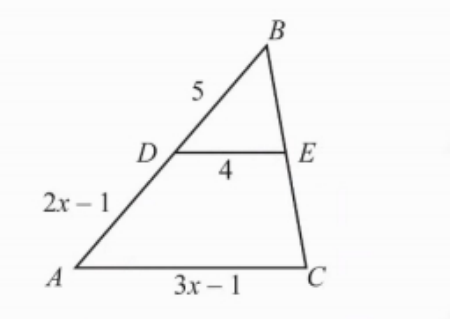
- A. 3
- B. 4
- C. 5
- D. 6
Correct Answer & Rationale
Correct Answer: A
In triangle ABC, since AC is parallel to DE, the segments AD and AC are proportional. This relationship can be expressed as AD = AC. Substituting the expressions gives us the equation: 2x - 1 = 3x - 1. Solving for x, we simplify to 2x - 3x = -1 + 1, leading to -x = 0, or x = 3. Option B (4), C (5), and D (6) do not satisfy the equation derived from the parallel lines, making them incorrect. Only x = 3 maintains the equality, confirming the proportional relationship in the triangle.
In triangle ABC, since AC is parallel to DE, the segments AD and AC are proportional. This relationship can be expressed as AD = AC. Substituting the expressions gives us the equation: 2x - 1 = 3x - 1. Solving for x, we simplify to 2x - 3x = -1 + 1, leading to -x = 0, or x = 3. Option B (4), C (5), and D (6) do not satisfy the equation derived from the parallel lines, making them incorrect. Only x = 3 maintains the equality, confirming the proportional relationship in the triangle.
Which of the following could be the function graphed above?
- A. f(x)=x+1
- B. f(x)=x-1
- C. f(x)=|x|+1
- D. f(x)=x-1
Correct Answer & Rationale
Correct Answer: C
Option C, \( f(x) = |x| + 1 \), accurately represents a V-shaped graph that opens upwards, with its vertex at (0, 1). This aligns with the characteristics of the graph shown. Option A, \( f(x) = x + 1 \), is a linear function with a slope of 1, resulting in a straight line, which does not match the V-shape. Option B, \( f(x) = x - 1 \), is another linear function with a slope of 1, also producing a straight line that does not fit the graph. Option D, \( f(x) = x - 1 \), is identical to Option B and shares the same linear characteristics, further confirming it cannot represent the V-shaped graph.
Option C, \( f(x) = |x| + 1 \), accurately represents a V-shaped graph that opens upwards, with its vertex at (0, 1). This aligns with the characteristics of the graph shown. Option A, \( f(x) = x + 1 \), is a linear function with a slope of 1, resulting in a straight line, which does not match the V-shape. Option B, \( f(x) = x - 1 \), is another linear function with a slope of 1, also producing a straight line that does not fit the graph. Option D, \( f(x) = x - 1 \), is identical to Option B and shares the same linear characteristics, further confirming it cannot represent the V-shaped graph.