Choose the best answer. If necessary, use the paper you were given.
Which of the following is NOT a factor of x^4 +x^3?
- A. X
- B. X + 1
- C. X^3
- D. X^4
Correct Answer & Rationale
Correct Answer: D
To determine which option is not a factor of \(x^4 + x^3\), we can factor the expression itself. Factoring out the greatest common factor, we have \(x^3(x + 1)\). - **Option A: X** is a factor since \(x\) is part of \(x^3\). - **Option B: X + 1** is a factor as it is the remaining term after factoring \(x^3\). - **Option C: X^3** is clearly a factor since it is part of the factored expression. **Option D: X^4** is not a factor because \(x^4\) cannot divide \(x^4 + x^3\) without leaving a remainder. Thus, it does not fit into the factorization.
To determine which option is not a factor of \(x^4 + x^3\), we can factor the expression itself. Factoring out the greatest common factor, we have \(x^3(x + 1)\). - **Option A: X** is a factor since \(x\) is part of \(x^3\). - **Option B: X + 1** is a factor as it is the remaining term after factoring \(x^3\). - **Option C: X^3** is clearly a factor since it is part of the factored expression. **Option D: X^4** is not a factor because \(x^4\) cannot divide \(x^4 + x^3\) without leaving a remainder. Thus, it does not fit into the factorization.
Other Related Questions
If the trend shown in the graph above continued into the next year, approximately how many sport utility vehicles were sold in 1999?
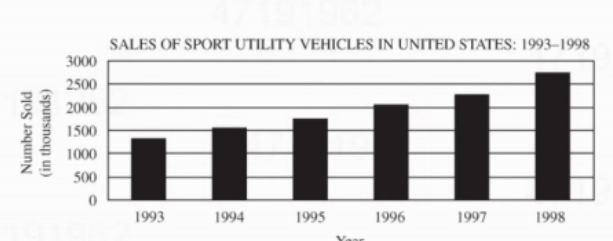
- A. 3 million
- B. 2.5 million
- C. 2 million
- D. 3 thousand
Correct Answer & Rationale
Correct Answer: A
To determine the approximate number of sport utility vehicles sold in 1999, analyzing the trend in the graph is essential. If the upward trend continued, sales would likely increase compared to previous years. Given the data, 3 million aligns with the projected growth rate, reflecting a significant rise consistent with market trends. Option B, 2.5 million, underestimates the growth, while C, 2 million, does not account for the upward trajectory. Option D, 3 thousand, is far too low and unrealistic, failing to represent the scale of SUV sales during that period. Thus, 3 million is the most reasonable estimate.
To determine the approximate number of sport utility vehicles sold in 1999, analyzing the trend in the graph is essential. If the upward trend continued, sales would likely increase compared to previous years. Given the data, 3 million aligns with the projected growth rate, reflecting a significant rise consistent with market trends. Option B, 2.5 million, underestimates the growth, while C, 2 million, does not account for the upward trajectory. Option D, 3 thousand, is far too low and unrealistic, failing to represent the scale of SUV sales during that period. Thus, 3 million is the most reasonable estimate.
Allison drives her car at an average speed of x miles per hour for y hours and travels 150 miles. Which of the following equations represents this situation?
- A. x + y = 150
- B. xy = 150
- C. y/x = 150
- D. x/y = 150
Correct Answer & Rationale
Correct Answer: B
The relationship between speed, time, and distance is expressed by the formula: distance = speed × time. In this scenario, Allison travels 150 miles at an average speed of x miles per hour for y hours, which translates to the equation xy = 150. Option A (x + y = 150) incorrectly suggests that speed and time add up to distance, which is not accurate. Option C (y/x = 150) misrepresents the relationship by implying that the ratio of time to speed equals distance, which is incorrect. Option D (x/y = 150) also misinterprets the relationship, suggesting that the ratio of speed to time equals distance. Thus, option B correctly captures the relationship among the variables.
The relationship between speed, time, and distance is expressed by the formula: distance = speed × time. In this scenario, Allison travels 150 miles at an average speed of x miles per hour for y hours, which translates to the equation xy = 150. Option A (x + y = 150) incorrectly suggests that speed and time add up to distance, which is not accurate. Option C (y/x = 150) misrepresents the relationship by implying that the ratio of time to speed equals distance, which is incorrect. Option D (x/y = 150) also misinterprets the relationship, suggesting that the ratio of speed to time equals distance. Thus, option B correctly captures the relationship among the variables.
Which of the following is a factor of u²+uv-2v²?
- A. (u-v)
- B. (2u-v)
- C. (u-2v)
- D. (u+v)
Correct Answer & Rationale
Correct Answer: C
To determine the factors of \( u^2 + uv - 2v^2 \), we can factor the expression. Option C, \( (u - 2v) \), is a valid factor. When we perform polynomial long division or synthetic division using \( (u - 2v) \), we find that it divides evenly, confirming it as a factor. Option A, \( (u - v) \), does not satisfy the factorization, as substituting \( v \) does not yield a zero remainder. Option B, \( (2u - v) \), also fails to factor the expression correctly, leading to a non-zero remainder upon division. Option D, \( (u + v) \), similarly does not yield a zero remainder, confirming it is not a factor. Thus, only \( (u - 2v) \) is a valid factor of the expression.
To determine the factors of \( u^2 + uv - 2v^2 \), we can factor the expression. Option C, \( (u - 2v) \), is a valid factor. When we perform polynomial long division or synthetic division using \( (u - 2v) \), we find that it divides evenly, confirming it as a factor. Option A, \( (u - v) \), does not satisfy the factorization, as substituting \( v \) does not yield a zero remainder. Option B, \( (2u - v) \), also fails to factor the expression correctly, leading to a non-zero remainder upon division. Option D, \( (u + v) \), similarly does not yield a zero remainder, confirming it is not a factor. Thus, only \( (u - 2v) \) is a valid factor of the expression.
The average of 5 numbers is 11. Which of the following must be true?
- A. The range of the 5 numbers is 55.
- B. The sum of the 5 numbers is 55.
- C. The median of 5 numbers is 11.
- D. The mode of 5 numbers is 11.
Correct Answer & Rationale
Correct Answer: B
To find the average of 5 numbers, you sum them and divide by 5. If the average is 11, the total sum must be 5 times 11, which equals 55. Thus, option B is true. Option A is incorrect; the range is the difference between the highest and lowest numbers, which can vary regardless of the average. Option C is also not necessarily true; the median, or middle value, can differ from the average depending on the distribution of the numbers. Option D is incorrect; the mode, or most frequently occurring number, does not have to be the same as the average.
To find the average of 5 numbers, you sum them and divide by 5. If the average is 11, the total sum must be 5 times 11, which equals 55. Thus, option B is true. Option A is incorrect; the range is the difference between the highest and lowest numbers, which can vary regardless of the average. Option C is also not necessarily true; the median, or middle value, can differ from the average depending on the distribution of the numbers. Option D is incorrect; the mode, or most frequently occurring number, does not have to be the same as the average.