Which of the following represents the cost, in dollars, of renting a car for d days and driving m miles?
- A. 45+.25+ d+m
- B. 45.25+ dm
- C. 45d +.25m
- D. 45/d +25/m
Correct Answer & Rationale
Correct Answer: C
Option C accurately represents the cost of renting a car, where $45 is a fixed daily rental fee multiplied by the number of days (d) and $0.25 is the cost per mile multiplied by the number of miles driven (m). Option A incorrectly adds the fixed cost and variable costs without proper multiplication, leading to an illogical expression. Option B misrepresents the relationship by multiplying the daily rate by the miles driven, which does not reflect the cost structure. Option D divides the fixed cost by days and the cost per mile by miles, which does not align with standard cost calculations for renting a car.
Option C accurately represents the cost of renting a car, where $45 is a fixed daily rental fee multiplied by the number of days (d) and $0.25 is the cost per mile multiplied by the number of miles driven (m). Option A incorrectly adds the fixed cost and variable costs without proper multiplication, leading to an illogical expression. Option B misrepresents the relationship by multiplying the daily rate by the miles driven, which does not reflect the cost structure. Option D divides the fixed cost by days and the cost per mile by miles, which does not align with standard cost calculations for renting a car.
Other Related Questions
The expressions x - 2 and x + 3 represent the length and width of a rectangle, respectively. If the area of the rectangle is 24, what is the perimeter of the rectangle?
- A. 20
- B. 22
- C. 24
- D. 28
Correct Answer & Rationale
Correct Answer: B
To find the perimeter of the rectangle, first calculate its dimensions using the area formula. The area is given by multiplying length and width: \[ (x - 2)(x + 3) = 24 \] Expanding this, we get: \[ x^2 + x - 6 = 24 \implies x^2 + x - 30 = 0 \] Factoring yields: \[ (x - 5)(x + 6) = 0 \implies x = 5 \text{ (valid)} \text{ or } x = -6 \text{ (not valid)} \] Using \(x = 5\), the dimensions are \(3\) (length) and \(8\) (width). The perimeter is: \[ 2(3 + 8) = 22 \] Options A (20), C (24), and D (28) do not match the calculated perimeter of 22, confirming they are incorrect.
To find the perimeter of the rectangle, first calculate its dimensions using the area formula. The area is given by multiplying length and width: \[ (x - 2)(x + 3) = 24 \] Expanding this, we get: \[ x^2 + x - 6 = 24 \implies x^2 + x - 30 = 0 \] Factoring yields: \[ (x - 5)(x + 6) = 0 \implies x = 5 \text{ (valid)} \text{ or } x = -6 \text{ (not valid)} \] Using \(x = 5\), the dimensions are \(3\) (length) and \(8\) (width). The perimeter is: \[ 2(3 + 8) = 22 \] Options A (20), C (24), and D (28) do not match the calculated perimeter of 22, confirming they are incorrect.
Which of the following is a factor of u²+uv-2v²?
- A. (u-v)
- B. (2u-v)
- C. (u-2v)
- D. (u+v)
Correct Answer & Rationale
Correct Answer: C
To determine the factors of \( u^2 + uv - 2v^2 \), we can factor the expression. Option C, \( (u - 2v) \), is a valid factor. When we perform polynomial long division or synthetic division using \( (u - 2v) \), we find that it divides evenly, confirming it as a factor. Option A, \( (u - v) \), does not satisfy the factorization, as substituting \( v \) does not yield a zero remainder. Option B, \( (2u - v) \), also fails to factor the expression correctly, leading to a non-zero remainder upon division. Option D, \( (u + v) \), similarly does not yield a zero remainder, confirming it is not a factor. Thus, only \( (u - 2v) \) is a valid factor of the expression.
To determine the factors of \( u^2 + uv - 2v^2 \), we can factor the expression. Option C, \( (u - 2v) \), is a valid factor. When we perform polynomial long division or synthetic division using \( (u - 2v) \), we find that it divides evenly, confirming it as a factor. Option A, \( (u - v) \), does not satisfy the factorization, as substituting \( v \) does not yield a zero remainder. Option B, \( (2u - v) \), also fails to factor the expression correctly, leading to a non-zero remainder upon division. Option D, \( (u + v) \), similarly does not yield a zero remainder, confirming it is not a factor. Thus, only \( (u - 2v) \) is a valid factor of the expression.
In the figure above, what is the average (arithmetic mean) of w, x, y, and z?
- A. 90
- B. 100
- C. 120
- D. It cannot be determined from the information given.
Correct Answer & Rationale
Correct Answer: D
To find the average of w, x, y, and z, all values must be known. Option D is valid since the problem does not provide specific values or relationships between these variables, making it impossible to calculate their average. Option A (90), Option B (100), and Option C (120) suggest definitive averages, but without concrete data on w, x, y, and z, these answers cannot be substantiated. Each of these options assumes values that may not exist or be accurate, highlighting the necessity of complete information for such calculations.
To find the average of w, x, y, and z, all values must be known. Option D is valid since the problem does not provide specific values or relationships between these variables, making it impossible to calculate their average. Option A (90), Option B (100), and Option C (120) suggest definitive averages, but without concrete data on w, x, y, and z, these answers cannot be substantiated. Each of these options assumes values that may not exist or be accurate, highlighting the necessity of complete information for such calculations.
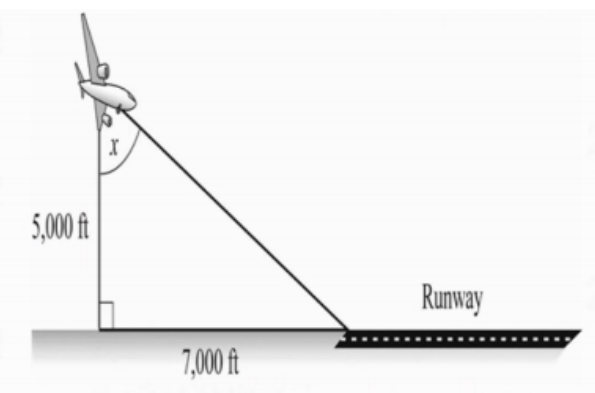
An airplane is 5,000 ft above ground and has to land on a runway that is 7,000 ft away as shown above. Let x be the angle the pilot takes to land the airplane at the beginning of the runway. Which equation is a correct way to calculate x?
- A. sin x = 5000/7000
- B. sin x = 7000/5000
- C. tan x = 5000/7000
- D. tan x = 7/5000
Correct Answer & Rationale
Correct Answer: C
To determine the angle \( x \) for landing, we need to consider the relationship between the height of the airplane and the distance to the runway. The height (5000 ft) is the opposite side of the right triangle formed, while the distance to the runway (7000 ft) is the adjacent side. The tangent function relates these two sides, hence \( \tan x = \frac{\text{opposite}}{\text{adjacent}} \) leads to \( \tan x = \frac{5000}{7000} \). Option A incorrectly uses the sine function, which relates the opposite side to the hypotenuse. Option B also misapplies sine but swaps the sides, leading to an incorrect ratio. Option D incorrectly uses tangent but misrepresents the sides, making it invalid. Thus, option C accurately represents the relationship needed to calculate angle \( x \).
To determine the angle \( x \) for landing, we need to consider the relationship between the height of the airplane and the distance to the runway. The height (5000 ft) is the opposite side of the right triangle formed, while the distance to the runway (7000 ft) is the adjacent side. The tangent function relates these two sides, hence \( \tan x = \frac{\text{opposite}}{\text{adjacent}} \) leads to \( \tan x = \frac{5000}{7000} \). Option A incorrectly uses the sine function, which relates the opposite side to the hypotenuse. Option B also misapplies sine but swaps the sides, leading to an incorrect ratio. Option D incorrectly uses tangent but misrepresents the sides, making it invalid. Thus, option C accurately represents the relationship needed to calculate angle \( x \).