Choose the best answer. If necessary, use the paper you were given.
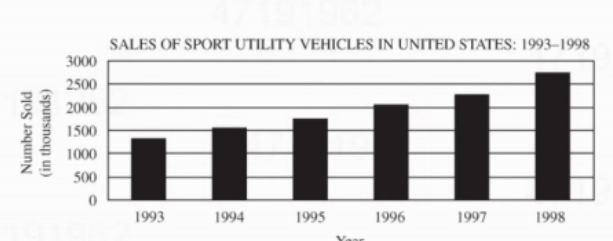
If the trend shown in the graph above continued into the next year, approximately how many sport utility vehicles were sold in 1999?
- A. 3 million
- B. 2.5 million
- C. 2 million
- D. 3 thousand
Correct Answer & Rationale
Correct Answer: A
To determine the approximate number of sport utility vehicles sold in 1999, analyzing the trend in the graph is essential. If the upward trend continued, sales would likely increase compared to previous years. Given the data, 3 million aligns with the projected growth rate, reflecting a significant rise consistent with market trends. Option B, 2.5 million, underestimates the growth, while C, 2 million, does not account for the upward trajectory. Option D, 3 thousand, is far too low and unrealistic, failing to represent the scale of SUV sales during that period. Thus, 3 million is the most reasonable estimate.
To determine the approximate number of sport utility vehicles sold in 1999, analyzing the trend in the graph is essential. If the upward trend continued, sales would likely increase compared to previous years. Given the data, 3 million aligns with the projected growth rate, reflecting a significant rise consistent with market trends. Option B, 2.5 million, underestimates the growth, while C, 2 million, does not account for the upward trajectory. Option D, 3 thousand, is far too low and unrealistic, failing to represent the scale of SUV sales during that period. Thus, 3 million is the most reasonable estimate.
Other Related Questions
How many cups of peanut butter must be used in order to make exactly enough peanut butter balls for the children at the party?
- A. 10
- B. 12
- C. 18
- D. 24
Correct Answer & Rationale
Correct Answer: C
To determine the number of cups of peanut butter needed for the peanut butter balls, one must consider the recipe's requirements and the number of children attending the party. Option C (18 cups) aligns with the recipe's proportion to yield the exact quantity necessary for all children. Option A (10 cups) is insufficient, likely resulting in fewer peanut butter balls than required. Option B (12 cups) may also fall short, leading to a shortage. Option D (24 cups) exceeds the needed amount, creating waste. Thus, C is the optimal choice, ensuring each child receives a peanut butter ball without excess or deficit.
To determine the number of cups of peanut butter needed for the peanut butter balls, one must consider the recipe's requirements and the number of children attending the party. Option C (18 cups) aligns with the recipe's proportion to yield the exact quantity necessary for all children. Option A (10 cups) is insufficient, likely resulting in fewer peanut butter balls than required. Option B (12 cups) may also fall short, leading to a shortage. Option D (24 cups) exceeds the needed amount, creating waste. Thus, C is the optimal choice, ensuring each child receives a peanut butter ball without excess or deficit.
A bowl contains 6 green grapes, 10 red grapes, and 8 black grapes.Which of the following is the correct calculation for the probability of choosing a red grape and then without putting the red grape back into the bowl, choosing a green grape?
- A. 10/24+6/24
- B. 10/24+6/23
- C. 10/24*6/24
- D. 10/24*6/23
Correct Answer & Rationale
Correct Answer: D
To determine the probability of selecting a red grape followed by a green grape without replacement, the first step involves calculating the probability of the first event (selecting a red grape). There are 10 red grapes out of a total of 24 grapes, giving a probability of 10/24. After choosing a red grape, there are now 23 grapes left in the bowl, including 6 green grapes. Thus, the probability of then selecting a green grape is 6/23. Option A incorrectly adds the probabilities, which is not appropriate for sequential events. Option B uses the correct second probability but fails to multiply the probabilities of the two events. Option C mistakenly adds both probabilities instead of multiplying them. Only option D correctly multiplies the probabilities of the two dependent events.
To determine the probability of selecting a red grape followed by a green grape without replacement, the first step involves calculating the probability of the first event (selecting a red grape). There are 10 red grapes out of a total of 24 grapes, giving a probability of 10/24. After choosing a red grape, there are now 23 grapes left in the bowl, including 6 green grapes. Thus, the probability of then selecting a green grape is 6/23. Option A incorrectly adds the probabilities, which is not appropriate for sequential events. Option B uses the correct second probability but fails to multiply the probabilities of the two events. Option C mistakenly adds both probabilities instead of multiplying them. Only option D correctly multiplies the probabilities of the two dependent events.
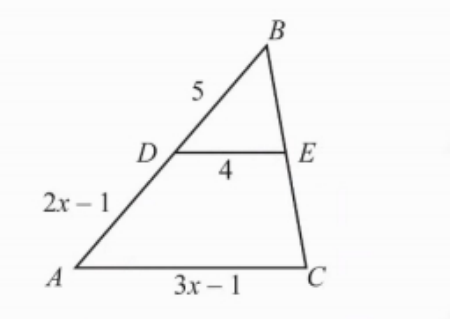
In triangle ABC above, AC ||DE. If AD = 2x - 1 and AC = 3x - 1 , what is the value of x ?
- A. 3
- B. 4
- C. 5
- D. 6
Correct Answer & Rationale
Correct Answer: A
In triangle ABC, since AC is parallel to DE, the segments AD and AC are proportional. This relationship can be expressed as AD = AC. Substituting the expressions gives us the equation: 2x - 1 = 3x - 1. Solving for x, we simplify to 2x - 3x = -1 + 1, leading to -x = 0, or x = 3. Option B (4), C (5), and D (6) do not satisfy the equation derived from the parallel lines, making them incorrect. Only x = 3 maintains the equality, confirming the proportional relationship in the triangle.
In triangle ABC, since AC is parallel to DE, the segments AD and AC are proportional. This relationship can be expressed as AD = AC. Substituting the expressions gives us the equation: 2x - 1 = 3x - 1. Solving for x, we simplify to 2x - 3x = -1 + 1, leading to -x = 0, or x = 3. Option B (4), C (5), and D (6) do not satisfy the equation derived from the parallel lines, making them incorrect. Only x = 3 maintains the equality, confirming the proportional relationship in the triangle.
If the values of x and y are negative, which of the following values must be positive?
- A. x²-y²
- B. x/y
- C. x+y
- D. x-y
Correct Answer & Rationale
Correct Answer: B
When both x and y are negative, the quotient \( x/y \) results in a positive value. This is because dividing a negative number by another negative number yields a positive outcome. Option A, \( x^2 - y^2 \), can be either positive or negative depending on the magnitudes of x and y; thus, it is not guaranteed to be positive. Option C, \( x + y \), is the sum of two negative numbers, which will always be negative. Option D, \( x - y \), involves subtracting a negative (y) from another negative (x), which can also yield a negative or zero result, depending on their values. Only \( x/y \) is assuredly positive.
When both x and y are negative, the quotient \( x/y \) results in a positive value. This is because dividing a negative number by another negative number yields a positive outcome. Option A, \( x^2 - y^2 \), can be either positive or negative depending on the magnitudes of x and y; thus, it is not guaranteed to be positive. Option C, \( x + y \), is the sum of two negative numbers, which will always be negative. Option D, \( x - y \), involves subtracting a negative (y) from another negative (x), which can also yield a negative or zero result, depending on their values. Only \( x/y \) is assuredly positive.