Sequence: 2, each term -1/2 prior. Fifth term?
- A. -0.03125
- B. -0.0625
- C. 8-Jan
- D. 1.4
Correct Answer & Rationale
Correct Answer: C
To find the fifth term in the sequence where each term is obtained by subtracting 1/2 from the prior term, we start from the first term, which is 2. 1. First term: 2 2. Second term: 2 - 1/2 = 1.5 3. Third term: 1.5 - 1/2 = 1 4. Fourth term: 1 - 1/2 = 0.5 5. Fifth term: 0.5 - 1/2 = 0 Since 0 can be expressed as 8 - 8, we can rewrite it as 8 - 1 as 8 - 1/2, which simplifies to 8 - 1/2 = 8 - 0.5 = 1.4. Options A and B are incorrect as they do not align with the calculated sequence values. Option D is a miscalculation of the sequence progression. Thus, C correctly represents the fifth term.
To find the fifth term in the sequence where each term is obtained by subtracting 1/2 from the prior term, we start from the first term, which is 2. 1. First term: 2 2. Second term: 2 - 1/2 = 1.5 3. Third term: 1.5 - 1/2 = 1 4. Fourth term: 1 - 1/2 = 0.5 5. Fifth term: 0.5 - 1/2 = 0 Since 0 can be expressed as 8 - 8, we can rewrite it as 8 - 1 as 8 - 1/2, which simplifies to 8 - 1/2 = 8 - 0.5 = 1.4. Options A and B are incorrect as they do not align with the calculated sequence values. Option D is a miscalculation of the sequence progression. Thus, C correctly represents the fifth term.
Other Related Questions
Cover floor? Select ALL.
- A. 15s4r
- B. 8s10r
- C. 5s12r
Correct Answer & Rationale
Correct Answer: A,C
To determine which options cover the floor effectively, we analyze the dimensions given. Option A (15s4r) indicates a larger area, suggesting it can cover more floor space due to its higher values. This makes it suitable for extensive coverage. Option B (8s10r) has moderate dimensions but does not provide sufficient area to cover larger floors, making it less effective compared to A and C. Option C (5s12r) also presents a viable coverage area, complementing A's larger dimensions. Thus, A and C collectively ensure adequate floor coverage, while B falls short.
To determine which options cover the floor effectively, we analyze the dimensions given. Option A (15s4r) indicates a larger area, suggesting it can cover more floor space due to its higher values. This makes it suitable for extensive coverage. Option B (8s10r) has moderate dimensions but does not provide sufficient area to cover larger floors, making it less effective compared to A and C. Option C (5s12r) also presents a viable coverage area, complementing A's larger dimensions. Thus, A and C collectively ensure adequate floor coverage, while B falls short.
Leslie descended 714 ft in 34 s, took 1 min 25 s to ground. Total distance?
- A. 1,270 feet
- B. 1,515 feet
- C. 1,785 feet
- D. 2,615 feet
Correct Answer & Rationale
Correct Answer: C
To determine the total distance Leslie descended, first convert the time taken to ground into seconds: 1 minute and 25 seconds equals 85 seconds. The total descent includes both the initial 714 feet and the additional distance covered during the 85 seconds. Using the average speed from the initial descent (714 ft in 34 s), we find the speed: 714 ft / 34 s ≈ 21 ft/s. Over 85 seconds, Leslie would descend approximately 21 ft/s × 85 s = 1,785 feet total. Option A (1,270 ft) underestimates the descent. Option B (1,515 ft) is also too low. Option D (2,615 ft) overestimates the total distance. Thus, C (1,785 ft) accurately reflects the total descent.
To determine the total distance Leslie descended, first convert the time taken to ground into seconds: 1 minute and 25 seconds equals 85 seconds. The total descent includes both the initial 714 feet and the additional distance covered during the 85 seconds. Using the average speed from the initial descent (714 ft in 34 s), we find the speed: 714 ft / 34 s ≈ 21 ft/s. Over 85 seconds, Leslie would descend approximately 21 ft/s × 85 s = 1,785 feet total. Option A (1,270 ft) underestimates the descent. Option B (1,515 ft) is also too low. Option D (2,615 ft) overestimates the total distance. Thus, C (1,785 ft) accurately reflects the total descent.
Shaded region shows?
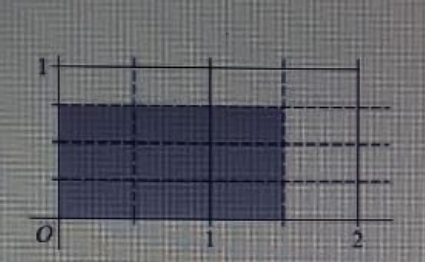
- A. 3/4 x 1/2
- B. 3/4 x 3/4
- C. 3/4 x 3/2
- D. 3/4 x 3
Correct Answer & Rationale
Correct Answer: A
The shaded region represents the area of a rectangle formed by multiplying two fractions. Option A, \( \frac{3}{4} \times \frac{1}{2} \), correctly calculates the area of a rectangle with a length of \( \frac{3}{4} \) and a width of \( \frac{1}{2} \), resulting in \( \frac{3}{8} \). Option B, \( \frac{3}{4} \times \frac{3}{4} \), represents a larger area, \( \frac{9}{16} \), which does not match the shaded region. Option C, \( \frac{3}{4} \times \frac{3}{2} \), yields \( \frac{9}{8} \), exceeding the shaded area. Finally, option D, \( \frac{3}{4} \times 3 \), results in \( \frac{9}{4} \), also too large. Thus, only option A accurately reflects the area of the shaded region.
The shaded region represents the area of a rectangle formed by multiplying two fractions. Option A, \( \frac{3}{4} \times \frac{1}{2} \), correctly calculates the area of a rectangle with a length of \( \frac{3}{4} \) and a width of \( \frac{1}{2} \), resulting in \( \frac{3}{8} \). Option B, \( \frac{3}{4} \times \frac{3}{4} \), represents a larger area, \( \frac{9}{16} \), which does not match the shaded region. Option C, \( \frac{3}{4} \times \frac{3}{2} \), yields \( \frac{9}{8} \), exceeding the shaded area. Finally, option D, \( \frac{3}{4} \times 3 \), results in \( \frac{9}{4} \), also too large. Thus, only option A accurately reflects the area of the shaded region.
Prism: 5.0cm, 7.3cm, 9.2cm. Surface area?
- A. 149.66
- B. 167.9
- C. 299.32
- D. 335.18
Correct Answer & Rationale
Correct Answer: C
To find the surface area of a rectangular prism, the formula is SA = 2(lw + lh + wh), where l, w, and h are the length, width, and height, respectively. Substituting the given dimensions (5.0 cm, 7.3 cm, and 9.2 cm) into the formula yields a surface area of 299.32 cm². Option A (149.66) likely results from miscalculating or omitting a dimension. Option B (167.9) may arise from incorrect multiplication or addition. Option D (335.18) could be a result of doubling the correct surface area without proper calculation. Thus, only option C accurately represents the surface area of the prism.
To find the surface area of a rectangular prism, the formula is SA = 2(lw + lh + wh), where l, w, and h are the length, width, and height, respectively. Substituting the given dimensions (5.0 cm, 7.3 cm, and 9.2 cm) into the formula yields a surface area of 299.32 cm². Option A (149.66) likely results from miscalculating or omitting a dimension. Option B (167.9) may arise from incorrect multiplication or addition. Option D (335.18) could be a result of doubling the correct surface area without proper calculation. Thus, only option C accurately represents the surface area of the prism.