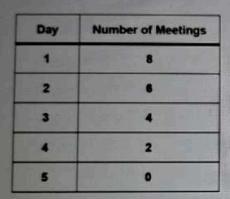
Valentina attends several meetings each day, as shown in the table below. Which of the following describes this pattern?
- A. The number of meetings increases by the same amount each day.
- B. The number of meetings decreases by the same amount each day.
- C. Each day, the number of meetings increases by the same percent over the previous day's number of meetings.
- D. Each day, the number of meetings decreases by the same percent over the previous day's number of meetings.
Correct Answer & Rationale
Correct Answer: C
The pattern of Valentina's meetings indicates that the number of meetings increases by a consistent percentage each day, reflecting exponential growth. This is evident when comparing the daily totals, which show a proportional rise rather than a fixed increase. Option A is incorrect because it suggests a linear growth, where the same number of meetings is added daily, which is not observed. Option B implies a consistent decrease, which contradicts the observed increase in meetings. Option D also misrepresents the data by suggesting a percentage decrease, which does not align with the trend of increasing meetings.
The pattern of Valentina's meetings indicates that the number of meetings increases by a consistent percentage each day, reflecting exponential growth. This is evident when comparing the daily totals, which show a proportional rise rather than a fixed increase. Option A is incorrect because it suggests a linear growth, where the same number of meetings is added daily, which is not observed. Option B implies a consistent decrease, which contradicts the observed increase in meetings. Option D also misrepresents the data by suggesting a percentage decrease, which does not align with the trend of increasing meetings.
Other Related Questions
Trevani bought a book. She paid a total of $13.50, including 8% sales tax. How much tax did Trevani pay on the book?
- A. $0.96
- B. $1.00
- C. $1.04
- D. $1.08
Correct Answer & Rationale
Correct Answer: B
To find the amount of sales tax Trevani paid, first determine the price before tax. The total amount paid, $13.50, includes an 8% tax. To find the pre-tax amount, divide the total by 1.08 (which accounts for the original price plus tax): $13.50 ÷ 1.08 = $12.50. Next, calculate the sales tax by subtracting the pre-tax amount from the total: $13.50 - $12.50 = $1.00. This confirms that Trevani paid $1.00 in tax. - Option A ($0.96) is incorrect as it underestimates the tax. - Option C ($1.04) slightly overestimates the tax. - Option D ($1.08) incorrectly assumes the total is all tax without accounting for the book's price.
To find the amount of sales tax Trevani paid, first determine the price before tax. The total amount paid, $13.50, includes an 8% tax. To find the pre-tax amount, divide the total by 1.08 (which accounts for the original price plus tax): $13.50 ÷ 1.08 = $12.50. Next, calculate the sales tax by subtracting the pre-tax amount from the total: $13.50 - $12.50 = $1.00. This confirms that Trevani paid $1.00 in tax. - Option A ($0.96) is incorrect as it underestimates the tax. - Option C ($1.04) slightly overestimates the tax. - Option D ($1.08) incorrectly assumes the total is all tax without accounting for the book's price.
For how many values of k is (x, y) = (k, -k) a solution to the equation 2x +2y = 0?
- A. None
- B. One
- C. Two
- D. More than two
Correct Answer & Rationale
Correct Answer: D
To determine how many values of \( k \) make \( (x, y) = (k, -k) \) a solution to the equation \( 2x + 2y = 0 \), substitute \( x \) and \( y \) into the equation. This gives \( 2k + 2(-k) = 0 \), which simplifies to \( 0 = 0 \). This statement is always true, meaning any value of \( k \) satisfies the equation. Option A (None) is incorrect; there are indeed solutions. Option B (One) is also wrong since infinitely many values of \( k \) work. Option C (Two) is insufficient, as there are not just two but infinitely many solutions. Hence, the correct interpretation is that there are more than two values of \( k \) that satisfy the equation.
To determine how many values of \( k \) make \( (x, y) = (k, -k) \) a solution to the equation \( 2x + 2y = 0 \), substitute \( x \) and \( y \) into the equation. This gives \( 2k + 2(-k) = 0 \), which simplifies to \( 0 = 0 \). This statement is always true, meaning any value of \( k \) satisfies the equation. Option A (None) is incorrect; there are indeed solutions. Option B (One) is also wrong since infinitely many values of \( k \) work. Option C (Two) is insufficient, as there are not just two but infinitely many solutions. Hence, the correct interpretation is that there are more than two values of \( k \) that satisfy the equation.
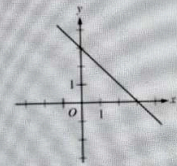
Which of the following could be an equation of the line graphed in the xy-plane above?
- A. y=-x-3
- B. y=-x+3
- C. y=x-3
- D. y=x+3
Correct Answer & Rationale
Correct Answer: D
To determine the equation of the line, we analyze its slope and y-intercept. The line in the graph has a positive slope, indicating that as \(x\) increases, \(y\) also increases. Option D, \(y = x + 3\), has a positive slope of 1 and a y-intercept of 3, aligning with the graph's characteristics. Option A, \(y = -x - 3\), has a negative slope and would decrease as \(x\) increases, which contradicts the graph. Option B, \(y = -x + 3\), also has a negative slope, leading to a downward trend. Option C, \(y = x - 3\), has a positive slope but a y-intercept of -3, placing it below the graph. Thus, D is the only option that fits the observed line.
To determine the equation of the line, we analyze its slope and y-intercept. The line in the graph has a positive slope, indicating that as \(x\) increases, \(y\) also increases. Option D, \(y = x + 3\), has a positive slope of 1 and a y-intercept of 3, aligning with the graph's characteristics. Option A, \(y = -x - 3\), has a negative slope and would decrease as \(x\) increases, which contradicts the graph. Option B, \(y = -x + 3\), also has a negative slope, leading to a downward trend. Option C, \(y = x - 3\), has a positive slope but a y-intercept of -3, placing it below the graph. Thus, D is the only option that fits the observed line.
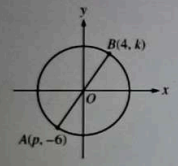
In the xy-plane above, the circle has center (0, 0) and AB is a diameter of the circle. What is the equation of the line passing through points A and B?
- A. y=-2/3 x
- B. y=2/3 x
- C. y=3/2 x
- D. y=4x
Correct Answer & Rationale
Correct Answer: B
The line passing through points A and B, which are endpoints of a diameter of the circle centered at (0, 0), must be a straight line that passes through the origin. Option B, \(y = \frac{2}{3}x\), represents a line with a positive slope, indicating that as x increases, y also increases, which is consistent with the properties of a diameter. Option A, \(y = -\frac{2}{3}x\), has a negative slope, suggesting a downward trend, which does not align with the upward direction of a diameter in the first quadrant. Option C, \(y = \frac{3}{2}x\), has a steeper slope than option B, which may not accurately represent the diameter's angle unless specified. Option D, \(y = 4x\), has an even steeper slope, making it unlikely to be the diameter unless A and B are positioned at extreme angles, which is not given in the problem.
The line passing through points A and B, which are endpoints of a diameter of the circle centered at (0, 0), must be a straight line that passes through the origin. Option B, \(y = \frac{2}{3}x\), represents a line with a positive slope, indicating that as x increases, y also increases, which is consistent with the properties of a diameter. Option A, \(y = -\frac{2}{3}x\), has a negative slope, suggesting a downward trend, which does not align with the upward direction of a diameter in the first quadrant. Option C, \(y = \frac{3}{2}x\), has a steeper slope than option B, which may not accurately represent the diameter's angle unless specified. Option D, \(y = 4x\), has an even steeper slope, making it unlikely to be the diameter unless A and B are positioned at extreme angles, which is not given in the problem.