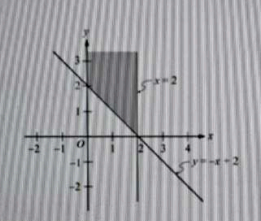
Which of the following points lies in the shaded region of the xy -plane above?
- A. (-1,1)
- B. (0,1)
- C. (1,2)
- D. (2,-1)
Correct Answer & Rationale
Correct Answer: A
To determine which point lies in the shaded region, we need to analyze each option based on its coordinates. Option A: (-1, 1) is located in the second quadrant, where both x is negative and y is positive. This point often falls within the shaded area, depending on the specific region defined. Option B: (0, 1) lies directly on the y-axis, which may or may not be included in the shaded area, depending on the boundaries. Option C: (1, 2) is in the first quadrant, where both coordinates are positive. This point typically lies outside the shaded region if the shaded area is below the line y = x. Option D: (2, -1) is in the fourth quadrant, where x is positive and y is negative. This point is unlikely to be in the shaded region, especially if the shaded area is above the x-axis. Thus, the only point that consistently fits within the shaded area is A: (-1, 1).
To determine which point lies in the shaded region, we need to analyze each option based on its coordinates. Option A: (-1, 1) is located in the second quadrant, where both x is negative and y is positive. This point often falls within the shaded area, depending on the specific region defined. Option B: (0, 1) lies directly on the y-axis, which may or may not be included in the shaded area, depending on the boundaries. Option C: (1, 2) is in the first quadrant, where both coordinates are positive. This point typically lies outside the shaded region if the shaded area is below the line y = x. Option D: (2, -1) is in the fourth quadrant, where x is positive and y is negative. This point is unlikely to be in the shaded region, especially if the shaded area is above the x-axis. Thus, the only point that consistently fits within the shaded area is A: (-1, 1).
Other Related Questions
For how many values of k is (x, y) = (k, -k) a solution to the equation 2x +2y = 0?
- A. None
- B. One
- C. Two
- D. More than two
Correct Answer & Rationale
Correct Answer: D
To determine how many values of \( k \) make \( (x, y) = (k, -k) \) a solution to the equation \( 2x + 2y = 0 \), substitute \( x \) and \( y \) into the equation. This gives \( 2k + 2(-k) = 0 \), which simplifies to \( 0 = 0 \). This statement is always true, meaning any value of \( k \) satisfies the equation. Option A (None) is incorrect; there are indeed solutions. Option B (One) is also wrong since infinitely many values of \( k \) work. Option C (Two) is insufficient, as there are not just two but infinitely many solutions. Hence, the correct interpretation is that there are more than two values of \( k \) that satisfy the equation.
To determine how many values of \( k \) make \( (x, y) = (k, -k) \) a solution to the equation \( 2x + 2y = 0 \), substitute \( x \) and \( y \) into the equation. This gives \( 2k + 2(-k) = 0 \), which simplifies to \( 0 = 0 \). This statement is always true, meaning any value of \( k \) satisfies the equation. Option A (None) is incorrect; there are indeed solutions. Option B (One) is also wrong since infinitely many values of \( k \) work. Option C (Two) is insufficient, as there are not just two but infinitely many solutions. Hence, the correct interpretation is that there are more than two values of \( k \) that satisfy the equation.
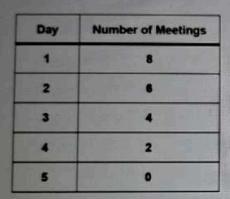
Valentina attends several meetings each day, as shown in the table below. Which of the following describes this pattern?
- A. The number of meetings increases by the same amount each day.
- B. The number of meetings decreases by the same amount each day.
- C. Each day, the number of meetings increases by the same percent over the previous day's number of meetings.
- D. Each day, the number of meetings decreases by the same percent over the previous day's number of meetings.
Correct Answer & Rationale
Correct Answer: C
The pattern of Valentina's meetings indicates that the number of meetings increases by a consistent percentage each day, reflecting exponential growth. This is evident when comparing the daily totals, which show a proportional rise rather than a fixed increase. Option A is incorrect because it suggests a linear growth, where the same number of meetings is added daily, which is not observed. Option B implies a consistent decrease, which contradicts the observed increase in meetings. Option D also misrepresents the data by suggesting a percentage decrease, which does not align with the trend of increasing meetings.
The pattern of Valentina's meetings indicates that the number of meetings increases by a consistent percentage each day, reflecting exponential growth. This is evident when comparing the daily totals, which show a proportional rise rather than a fixed increase. Option A is incorrect because it suggests a linear growth, where the same number of meetings is added daily, which is not observed. Option B implies a consistent decrease, which contradicts the observed increase in meetings. Option D also misrepresents the data by suggesting a percentage decrease, which does not align with the trend of increasing meetings.
If |x|+|y| = 4 and x ≠y, then x CANNOT be equal to
- A. 2
- C. -2
- D. -5
Correct Answer & Rationale
Correct Answer: D
The equation |x| + |y| = 4 defines a diamond-shaped region in the coordinate plane, where the sum of the absolute values of x and y equals 4. Option A (2) is possible since |2| + |y| = 4 allows y to be 2 or -2. Option C (-2) is also valid, as |-2| + |y| = 4 permits y to be 2 or -2. Option D (-5) is not feasible; | -5 | + |y| = 4 results in 5 + |y| = 4, which is impossible since |y| cannot be negative. Thus, -5 cannot satisfy the given equation while ensuring x ≠ y.
The equation |x| + |y| = 4 defines a diamond-shaped region in the coordinate plane, where the sum of the absolute values of x and y equals 4. Option A (2) is possible since |2| + |y| = 4 allows y to be 2 or -2. Option C (-2) is also valid, as |-2| + |y| = 4 permits y to be 2 or -2. Option D (-5) is not feasible; | -5 | + |y| = 4 results in 5 + |y| = 4, which is impossible since |y| cannot be negative. Thus, -5 cannot satisfy the given equation while ensuring x ≠ y.
Each of the following is a solution to the equation x- 2y = 4 EXCEPT
- A. (-2,-3)
- B. (0,2)
- C. (4,0)
- D. (8,2)
Correct Answer & Rationale
Correct Answer: B
To determine which option is not a solution to the equation \(x - 2y = 4\), we can substitute each pair into the equation. - For A: \((-2, -3)\), substituting gives \(-2 - 2(-3) = -2 + 6 = 4\), which is correct. - For B: \((0, 2)\), substituting gives \(0 - 2(2) = 0 - 4 = -4\), which does not equal 4, making this option incorrect. - For C: \((4, 0)\), substituting gives \(4 - 2(0) = 4\), which is correct. - For D: \((8, 2)\), substituting gives \(8 - 2(2) = 8 - 4 = 4\), which is correct. Thus, option B is the only pair that does not satisfy the equation.
To determine which option is not a solution to the equation \(x - 2y = 4\), we can substitute each pair into the equation. - For A: \((-2, -3)\), substituting gives \(-2 - 2(-3) = -2 + 6 = 4\), which is correct. - For B: \((0, 2)\), substituting gives \(0 - 2(2) = 0 - 4 = -4\), which does not equal 4, making this option incorrect. - For C: \((4, 0)\), substituting gives \(4 - 2(0) = 4\), which is correct. - For D: \((8, 2)\), substituting gives \(8 - 2(2) = 8 - 4 = 4\), which is correct. Thus, option B is the only pair that does not satisfy the equation.