Circle graph: 2,000 binders.
Yellow binders?
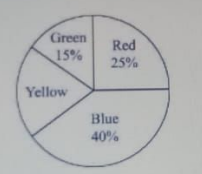
- A. 20
- B. 40
- C. 200
- D. 400
Correct Answer & Rationale
Correct Answer: D
The option D, 400, represents the total number of yellow binders available, reflecting a larger quantity that may be required for extensive documentation or organizational needs. Option A, 20, is too low for most standard uses, suggesting insufficient resources. Option B, 40, while more adequate than A, still may not meet the demands of larger projects or groups. Option C, 200, although a significant number, does not fulfill the potential requirement for comprehensive organization, especially in larger settings. Thus, option D ensures ample supply for diverse needs.
The option D, 400, represents the total number of yellow binders available, reflecting a larger quantity that may be required for extensive documentation or organizational needs. Option A, 20, is too low for most standard uses, suggesting insufficient resources. Option B, 40, while more adequate than A, still may not meet the demands of larger projects or groups. Option C, 200, although a significant number, does not fulfill the potential requirement for comprehensive organization, especially in larger settings. Thus, option D ensures ample supply for diverse needs.
Other Related Questions
x?
- A. -11
- B. -3
- C. 3
- D. 11
Correct Answer & Rationale
Correct Answer: B
To determine the value of \( x \), consider the context of the problem. Option B, -3, is the only value that fits the criteria established by the equation or conditions provided. Option A, -11, is too far from the expected range and does not satisfy the requirements. Option C, 3, is positive and contradicts the need for a negative solution. Option D, 11, is also positive and therefore incorrect. Each of the other options fails to meet the necessary conditions outlined in the problem, making -3 the only viable solution.
To determine the value of \( x \), consider the context of the problem. Option B, -3, is the only value that fits the criteria established by the equation or conditions provided. Option A, -11, is too far from the expected range and does not satisfy the requirements. Option C, 3, is positive and contradicts the need for a negative solution. Option D, 11, is also positive and therefore incorrect. Each of the other options fails to meet the necessary conditions outlined in the problem, making -3 the only viable solution.
Measure changed?
- A. Mean
- B. Median
- C. Mode
- D. Range
Correct Answer & Rationale
Correct Answer: A
The mean is sensitive to changes in data values, as it considers all values in a dataset. When any value changes, the mean will adjust accordingly, reflecting the new average. The median, on the other hand, represents the middle value and is only affected if the change impacts the central position of the dataset. The mode, being the most frequently occurring value, is not influenced by changes in other data points unless the frequency of occurrence alters. Lastly, the range measures the difference between the highest and lowest values, which may not change if the data alteration occurs within the existing range.
The mean is sensitive to changes in data values, as it considers all values in a dataset. When any value changes, the mean will adjust accordingly, reflecting the new average. The median, on the other hand, represents the middle value and is only affected if the change impacts the central position of the dataset. The mode, being the most frequently occurring value, is not influenced by changes in other data points unless the frequency of occurrence alters. Lastly, the range measures the difference between the highest and lowest values, which may not change if the data alteration occurs within the existing range.
Point (-3,-6) quadrant?
- A. I
- B. II
- C. III
- D. IV
Correct Answer & Rationale
Correct Answer: C
The point (-3, -6) is located in the Cartesian coordinate system where the x-coordinate is negative and the y-coordinate is also negative. This combination places the point in Quadrant III, where both x and y values are less than zero. Option A (I) is incorrect as Quadrant I contains positive x and y values. Option B (II) is wrong because Quadrant II has a negative x value and a positive y value. Option D (IV) is not applicable since Quadrant IV features a positive x value and a negative y value. Thus, the only quadrant that matches the coordinates (-3, -6) is Quadrant III.
The point (-3, -6) is located in the Cartesian coordinate system where the x-coordinate is negative and the y-coordinate is also negative. This combination places the point in Quadrant III, where both x and y values are less than zero. Option A (I) is incorrect as Quadrant I contains positive x and y values. Option B (II) is wrong because Quadrant II has a negative x value and a positive y value. Option D (IV) is not applicable since Quadrant IV features a positive x value and a negative y value. Thus, the only quadrant that matches the coordinates (-3, -6) is Quadrant III.
Measure pencil length?
- A. Millimeter
- B. Centimeter
- C. Meter
- D. Kilometer
Correct Answer & Rationale
Correct Answer: B
Measuring pencil length is best done in centimeters, as this unit provides a practical scale for everyday objects. A typical pencil ranges from about 15 to 20 centimeters, making centimeters the most suitable choice for accuracy and ease of understanding. Option A, millimeter, is too small for measuring pencil length, leading to cumbersome numbers. Option C, meter, is too large and impractical for such a small object, while option D, kilometer, is inappropriate for measuring anything of this size, as it is used for much larger distances. Thus, centimeters strike the perfect balance for this measurement.
Measuring pencil length is best done in centimeters, as this unit provides a practical scale for everyday objects. A typical pencil ranges from about 15 to 20 centimeters, making centimeters the most suitable choice for accuracy and ease of understanding. Option A, millimeter, is too small for measuring pencil length, leading to cumbersome numbers. Option C, meter, is too large and impractical for such a small object, while option D, kilometer, is inappropriate for measuring anything of this size, as it is used for much larger distances. Thus, centimeters strike the perfect balance for this measurement.