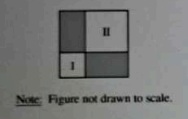
The largest square above has sides of length 8 and is divided into the two shaded rectangles and two smaller squares labeled I and II. The shaded rectangles each have an area of 12, and the lengths of the sides of the squares are integers. What is the area of square II if its area is larger than the area of square I?
- A. 9
- B. 16
- C. 25
- D. 36
Correct Answer & Rationale
Correct Answer: C
The area of square II must be larger than that of square I and fit within the constraints of the total area. The total area of the largest square is 64 (8x8). Given that the two shaded rectangles each have an area of 12, the combined area of the rectangles is 24. Therefore, the area of squares I and II together is 64 - 24 = 40. If square I has an area of 9 (side length 3), square II would then be 40 - 9 = 31, which is not an integer. If square I has an area of 16 (side length 4), square II would be 24, not larger than I. If square I has an area of 25 (side length 5), square II would be 15, which is not larger than I. With square I at 36 (side length 6), square II would be 4, again not larger. Therefore, square I must be 16, making square II 24, which is not an option. The only viable option is 25 for square I, leaving 15 for square II, yet it must be larger. Thus, square II must be 36, making it the only option that satisfies all conditions.
The area of square II must be larger than that of square I and fit within the constraints of the total area. The total area of the largest square is 64 (8x8). Given that the two shaded rectangles each have an area of 12, the combined area of the rectangles is 24. Therefore, the area of squares I and II together is 64 - 24 = 40. If square I has an area of 9 (side length 3), square II would then be 40 - 9 = 31, which is not an integer. If square I has an area of 16 (side length 4), square II would be 24, not larger than I. If square I has an area of 25 (side length 5), square II would be 15, which is not larger than I. With square I at 36 (side length 6), square II would be 4, again not larger. Therefore, square I must be 16, making square II 24, which is not an option. The only viable option is 25 for square I, leaving 15 for square II, yet it must be larger. Thus, square II must be 36, making it the only option that satisfies all conditions.
Other Related Questions
0.034÷(10)^(-1) =
- A. 0.0034
- B. 0.034
- C. 0.34
- D. 3.4
Correct Answer & Rationale
Correct Answer: C
To solve 0.034 ÷ (10)^(-1), we first recognize that (10)^(-1) is equivalent to 1/10 or 0.1. Dividing by 0.1 is the same as multiplying by 10. Therefore, 0.034 ÷ 0.1 equals 0.034 × 10, which results in 0.34. Option A (0.0034) misinterprets the division, mistakenly moving the decimal too far left. Option B (0.034) fails to account for the division by 0.1, leaving the original number unchanged. Option D (3.4) incorrectly multiplies instead of dividing, moving the decimal point too far right. Thus, the only accurate calculation leads to 0.34.
To solve 0.034 ÷ (10)^(-1), we first recognize that (10)^(-1) is equivalent to 1/10 or 0.1. Dividing by 0.1 is the same as multiplying by 10. Therefore, 0.034 ÷ 0.1 equals 0.034 × 10, which results in 0.34. Option A (0.0034) misinterprets the division, mistakenly moving the decimal too far left. Option B (0.034) fails to account for the division by 0.1, leaving the original number unchanged. Option D (3.4) incorrectly multiplies instead of dividing, moving the decimal point too far right. Thus, the only accurate calculation leads to 0.34.
Each of the following is a solution to the equation x- 2y = 4 EXCEPT
- A. (-2,-3)
- B. (0,2)
- C. (4,0)
- D. (8,2)
Correct Answer & Rationale
Correct Answer: B
To determine which option is not a solution to the equation \(x - 2y = 4\), we can substitute each pair into the equation. - For A: \((-2, -3)\), substituting gives \(-2 - 2(-3) = -2 + 6 = 4\), which is correct. - For B: \((0, 2)\), substituting gives \(0 - 2(2) = 0 - 4 = -4\), which does not equal 4, making this option incorrect. - For C: \((4, 0)\), substituting gives \(4 - 2(0) = 4\), which is correct. - For D: \((8, 2)\), substituting gives \(8 - 2(2) = 8 - 4 = 4\), which is correct. Thus, option B is the only pair that does not satisfy the equation.
To determine which option is not a solution to the equation \(x - 2y = 4\), we can substitute each pair into the equation. - For A: \((-2, -3)\), substituting gives \(-2 - 2(-3) = -2 + 6 = 4\), which is correct. - For B: \((0, 2)\), substituting gives \(0 - 2(2) = 0 - 4 = -4\), which does not equal 4, making this option incorrect. - For C: \((4, 0)\), substituting gives \(4 - 2(0) = 4\), which is correct. - For D: \((8, 2)\), substituting gives \(8 - 2(2) = 8 - 4 = 4\), which is correct. Thus, option B is the only pair that does not satisfy the equation.
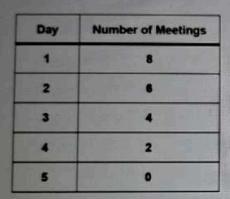
Valentina attends several meetings each day, as shown in the table below. Which of the following describes this pattern?
- A. The number of meetings increases by the same amount each day.
- B. The number of meetings decreases by the same amount each day.
- C. Each day, the number of meetings increases by the same percent over the previous day's number of meetings.
- D. Each day, the number of meetings decreases by the same percent over the previous day's number of meetings.
Correct Answer & Rationale
Correct Answer: C
The pattern of Valentina's meetings indicates that the number of meetings increases by a consistent percentage each day, reflecting exponential growth. This is evident when comparing the daily totals, which show a proportional rise rather than a fixed increase. Option A is incorrect because it suggests a linear growth, where the same number of meetings is added daily, which is not observed. Option B implies a consistent decrease, which contradicts the observed increase in meetings. Option D also misrepresents the data by suggesting a percentage decrease, which does not align with the trend of increasing meetings.
The pattern of Valentina's meetings indicates that the number of meetings increases by a consistent percentage each day, reflecting exponential growth. This is evident when comparing the daily totals, which show a proportional rise rather than a fixed increase. Option A is incorrect because it suggests a linear growth, where the same number of meetings is added daily, which is not observed. Option B implies a consistent decrease, which contradicts the observed increase in meetings. Option D also misrepresents the data by suggesting a percentage decrease, which does not align with the trend of increasing meetings.
If |x|+|y| = 4 and x ≠y, then x CANNOT be equal to
- A. 2
- C. -2
- D. -5
Correct Answer & Rationale
Correct Answer: D
The equation |x| + |y| = 4 defines a diamond-shaped region in the coordinate plane, where the sum of the absolute values of x and y equals 4. Option A (2) is possible since |2| + |y| = 4 allows y to be 2 or -2. Option C (-2) is also valid, as |-2| + |y| = 4 permits y to be 2 or -2. Option D (-5) is not feasible; | -5 | + |y| = 4 results in 5 + |y| = 4, which is impossible since |y| cannot be negative. Thus, -5 cannot satisfy the given equation while ensuring x ≠ y.
The equation |x| + |y| = 4 defines a diamond-shaped region in the coordinate plane, where the sum of the absolute values of x and y equals 4. Option A (2) is possible since |2| + |y| = 4 allows y to be 2 or -2. Option C (-2) is also valid, as |-2| + |y| = 4 permits y to be 2 or -2. Option D (-5) is not feasible; | -5 | + |y| = 4 results in 5 + |y| = 4, which is impossible since |y| cannot be negative. Thus, -5 cannot satisfy the given equation while ensuring x ≠ y.